
By: ThinkBusiness Africa
Rwanda’s greatest economic challenge has historically been its geography. Being landlocked often means high costs for trade and limited access to global markets. RwandAir is the state’s primary tool for “unlocking” the nation.
While critics often point to the heavy government subsidies required to keep the carrier aloft, the Rwandan government views these not as “bailouts,” but as strategic down payments on the country’s future.
Rwanda’s 2025/26 National Budget specifically allocated funds to reflect direct subsidies for RwandAir. This is viewed as an investment in the “Aviation Ecosystem,” which is expected to support a 7.5% national GDP growth in 2026.
For the fiscal year ending in 2024, RwandAir recorded total revenues of $464 million. This represents a massive 82% increase from the $253 million recorded in 2022.
Breaking the “Landlocked” Trap
By early 2026, data revealed that air travelers account for over 80% of Rwanda’s foreign exchange earnings from tourism. By controlling the “pipes” through which high-value visitors flow, Rwanda ensures that the wealth generated by gorilla trekking and luxury eco-tourism remains within its borders.
According to the 2025 Semester 1 Travel Expenditure Survey, air travelers accounted for 83% of all foreign travel earnings in Rwanda with $101.1 million recorded in the second quarter of 2025 alone, while land travelers contributed only 17%.
The airline’s pivot to cargo has allowed Rwandan exporters to bypass slow, expensive road networks through neighboring countries. In 2025, the carrier’s dedicated freighters became the primary artery for fresh agricultural exports—like the famed Rwandan chili and specialty coffee—reaching markets in Europe and the Middle East within 24 hours.
The “Singapore of Africa” Strategy
The 2025/2026 fiscal year saw Rwanda increase its spending to 28.7% of GDP, a significant portion of which was funneled into “priority investments”: RwandAir and the new Bugesera International Airport.
Much like Singapore’s Changi or Dubai’s Emirates, Rwanda is building a “transit economy.” Currently, over 60% of RwandAir’s traffic consists of transit passengers. These travelers may never leave the airport, but their fees, fuel consumption, and connection requirements fund thousands of local jobs and support a burgeoning aviation services industry.
Connectivity is the first question asked by international investors. By maintaining direct daily flights to London, Paris, and Dubai, Rwanda makes it easy for global CEOs to view Kigali as a viable regional headquarters, sparking a “halo effect” of investment in tech and finance.
“The increased spending will support the construction of a new international airport and government priorities… Government investment is projected to increase… reflecting both spending on Bugesera and RwandAir projects.” Yusuf Murangwa, Rwanda’s Minister of Finance said.
The Qatar Partnership
The finalized 49% stake acquisition by Qatar Airways in 2025 has provided the financial “muscle” to back Rwanda’s ambition. This partnership has turned RwandAir into a credible global competitor, offering: Joint procurement and technical support to reduce the massive overhead of running a modern fleet.
Access to Qatar Airways’ massive network allows RwandAir to sell tickets to virtually any city on Earth, effectively making Kigali a global gateway.
“For a medium-sized airline like ours, operational costs really put a strain on our operations… but we are really focused on connecting Rwanda to the rest of African countries and beyond.” Yvonne Manzi Makolo, CEO of RwandAir said speaking on the balance between cost and the mission to bridge African connectivity gaps.
More Than Just an Airline
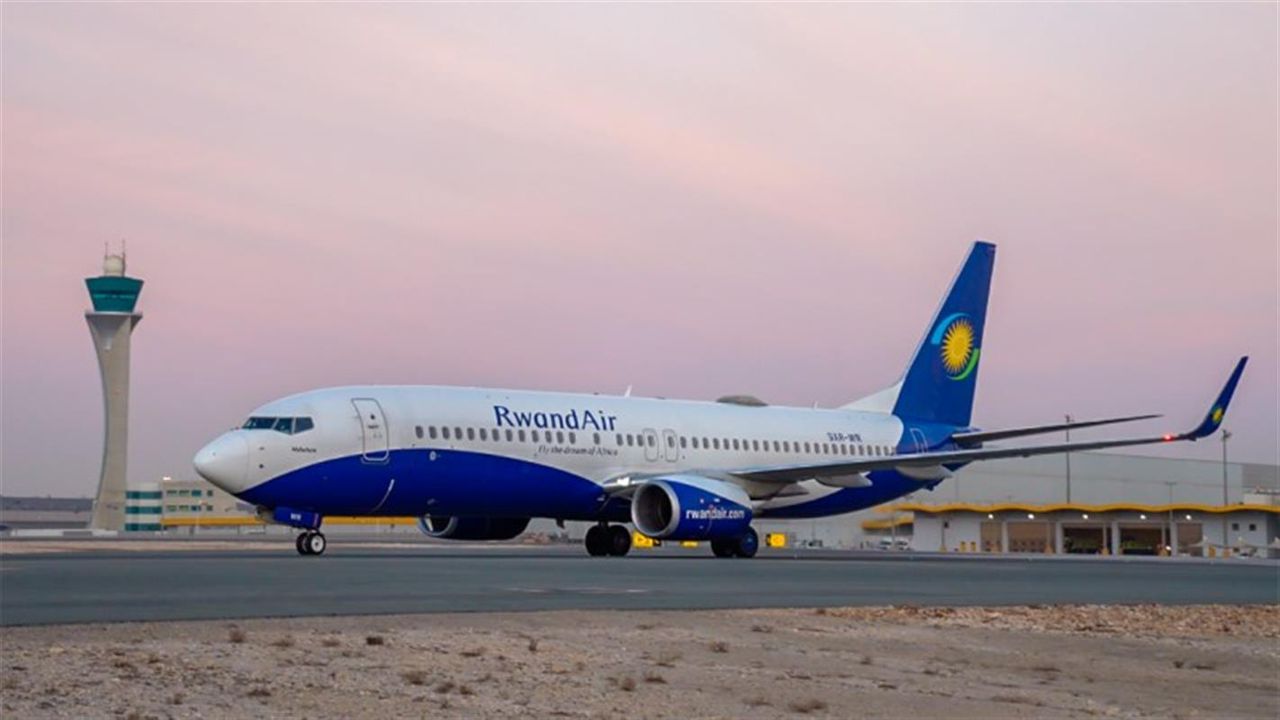
The airline’s steady growth took a significant leap in 2025 with the addition of two modern Boeing 737-800 aircraft in August, a move that reflects both ambition and preparation for a new aviation era anchored by the upcoming Bugesera International Airport.
With the latest addition RwandAir’s fleet now stands at 16 aircraft, which flies all over the world.
The fleet includes three Airbus A330s — connecting Kigali to Europe and Asia; six Boeing 737s — the workhorses for regional and medium-haul routes including the new -800 models; two Bombardier CRJ900s, which efficiently serve thinner regional routes; and two De Havilland Canada Dash 8-Q400s, turboprops used for short-haul flights within the East African region.
RwandAir currently operates flights to two domestic destinations and 25 international destinations across 18 countries, spanning Africa, the Middle East, Europe, and Asia.
Over the next five years, the airline plans to increase its fleet to 28 aircraft, expanding its reach to new long-haul markets while improving connectivity within Africa.
As the fleet prepares to grow to 28 aircraft by 2029, the message from Kigali is clear: RwandAir is the infrastructure of the 21st century. In a world where speed is currency, Rwanda’s investment in its national carrier is the most effective way to ensure its economy doesn’t just grow—it soars.