
The proposed Dangote East Africa Refinery — a 650,000 barrel per day facility to be located at Tanga Port in northeastern Tanzania — is the most significant energy infrastructure commitment on the continent since the construction of the Dangote Lekki refinery in Lagos. Announced at the Africa Finance Corporation’s ‘Africa We Build Summit in Nairobi in April 2026’, the project would serve as the downstream anchor of a fully integrated energy corridor stretching from landlocked crude producers in the Great Lakes region to the Indian Ocean coast.
The latest Africa Business Convention investment brief sets out the project’s parameters: the infrastructure already in place, the current state of diplomatic engagement, the economic impact across energy, trade, employment, and capital markets, and the seven risk categories that require active management before the project advances from political pledge to bankable groundbreaking.
THE SUPPLY GAP THAT CREATED THIS MOMENT
Africa imports more than 70 percent of its refined petroleum, at a cost the continent cannot indefinitely sustain. The Africa Finance Corporation projects a continental fuel shortfall of 86 million tonnes by 2040 — the equivalent of nearly three Dangote-scale refineries — and no credible pipeline of refining capacity currently exists to close that gap. East Africa is among the most exposed sub-regions: fuel import dependency runs at close to 100 percent, with the $11.8 billion annual import bill representing one of the single largest sources of foreign exchange outflow across the region.
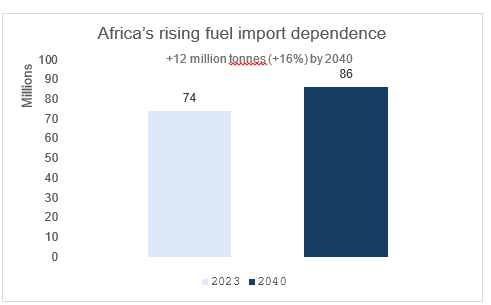
Source: Africa Finance Corporation (AFC), State of Africa’s Infrastructure Report 2026, April 2026
The 2026 Strait of Hormuz disruption sharpened that exposure into a policy emergency. With supply routes tightened and fuel costs spiking across the region, governments that had treated refining capacity as a long-term ambition found themselves under immediate pressure to act. The timing of Aliko Dangote’s announcement at the AFC’s Africa We Build Summit in Nairobi in April 2026 — a 650,000 barrel per day refinery at Tanga Port in Tanzania — was not coincidental. Supply-side urgency and political will are rarely present simultaneously; for Tanga, they are.
Key Takeaway East Africa’s fuel import dependency is a structural balance-of-payments problem, not a policy preference. The $11.8 billion annual import bill is the economic case for the Tanga refinery, and the Hormuz disruption is what converted that case from compelling to urgent for the governments that need to say yes.
THE PROJECT: PARAMETERS AND LOCATION LOGIC
The proposed Dangote East Africa Refinery would process crude from Uganda, the DRC, South Sudan, and Kenya at a target throughput of 650,000 barrels per day — matching the nameplate capacity of the Lagos facility and making it, at full operation, the largest refinery in sub-Saharan Africa. Refined output would be distributed across Tanzania, Kenya, Uganda, Rwanda, and the DRC, with surplus volumes available for export via Indian Ocean shipping routes to Asian and Middle Eastern markets.
| Location | Tanga Port, NE Tanzania |
| Capacity | 650,000 barrels per day |
| Estimated cost | ~$15–20 billion (based on Nigeria Lekki precedent) |
| Pipeline backbone | EACOP — 1,443 km from Uganda’s Lake Albert to Tanga, 82% complete |
| Crude sources | Uganda, DRC, South Sudan, Kenya |
| Distribution markets | Tanzania, Kenya, Uganda, Rwanda, DRC and Indian Ocean export routes |
| Government partners | Tanzania, Kenya, Uganda, DRC, South Sudan |
| Construction timeline | 4–5 years from agreement (Dangote pledge); 7–10 years (planning horizon based on Nigeria precedent) |
| Current status | Announcement and early negotiation phase. No signed MOU or financing confirmed. |
Tanga Port is not an arbitrary choice of location. Three factors make it the only commercially viable site for a refinery of this scale in East Africa. It is the Indian Ocean terminus of the East African Crude Oil Pipeline — the 1,443-kilometre heated pipeline running from Uganda’s Tilenga and Kingfisher oil fields — which provides the only infrastructure capable of moving landlocked East African crude to the coast at commercial volumes. Its deep-water berths are certified for Very Large Crude Carriers, enabling direct access to export markets without transshipment. And the port sits within Tanzania’s Special Economic Zone framework, which provides the tax and regulatory incentives required for a project of this capital intensity to pencil commercially. No other port in the region combines all three.
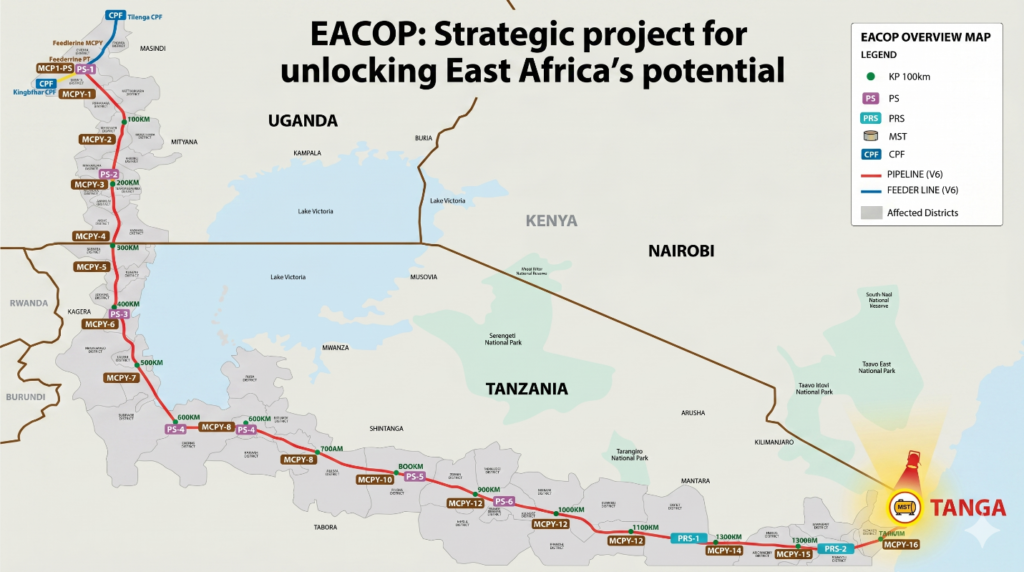
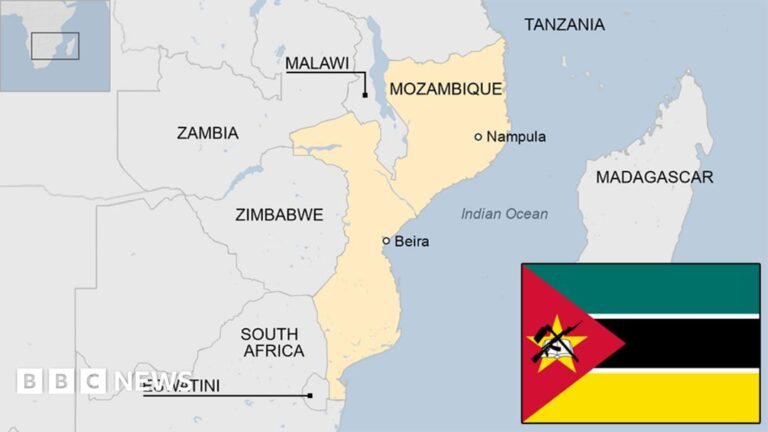
Fig 1: The East Africa Crude Oil Pipeline Route
The operational linkage between EACOP and the refinery is non-negotiable. At 82 percent complete as of early 2026, EACOP is the primary crude supply route. Without its completion, the refinery has no feedstock. The two projects are inseparable in both timing and commercial logic.
Key Takeaway The refinery site is determined by infrastructure, not preference. Tanga’s combination of pipeline terminus, VLCC-capable deep-water access, and SEZ status makes it the singular viable location. Investors pricing this project should treat EACOP completion as a pre-condition, not a parallel track.
POLITICAL COMMITMENT VS. BANKABLE PROJECT
The diplomatic momentum behind the Tanga refinery is, by the standards of comparable African infrastructure projects, unusually broad at this early stage. Kenya’s President Ruto confirmed pipeline support from Mombasa to Tanga at the Nairobi summit. Uganda’s President Museveni confirmed a crude supply commitment and named EACOP as the delivery mechanism. Tanzania is in active negotiation with the Dangote Group. DRC and South Sudan have been identified as crude suppliers, though no formal engagement from either government has been publicly confirmed.
The gap between political commitment and bankable project is, however, substantial. As of April 2026, no signed MOU, feasibility study mandate, project governance structure, or financing arrangement for Tanzania has been publicly confirmed.
Key Takeaway Political will is present across multiple governments simultaneously — a genuinely unusual condition for a project of this complexity. What is absent is the contractual framework. The window for shaping that framework is now, before positions harden and commercial terms are set by others.
ECONOMIC IMPACT: THE FOUR CHANNELS
A 650,000 bpd refinery at full capacity moves East Africa from approximately 75 percent fuel import dependency toward meaningful partial self-sufficiency. The foreign exchange effect is direct: Tanzania alone spent an estimated $2.5 billion on petroleum imports in 2024, and domestic refining at scale would materially reduce that outflow and relieve pressure on central bank reserves across the region.
On trade, the refinery creates intra-African flows that currently do not exist — crude from Uganda via EACOP in, refined products out to Kenya, Uganda, Rwanda, and the DRC — directly aligned with AfCFTA’s architecture and positioning Tanzania as a net energy exporter for the first time. On employment, direct construction and operational jobs are estimated at 50,000 to 100,000, with a larger indirect multiplier across logistics and services. The longer-term industrial consequence — downstream petrochemicals, fertiliser production, plastics manufacturing — is the more significant figure for the region’s manufacturing trajectory.
Key Takeaway The refinery’s economic significance is not primarily in the jobs or barrels — it is in the structural reorientation it enables: from import dependency to regional production, from net energy buyer to net energy exporter, and from a region that sends capital to Rotterdam to one that retains it at Tanga.
RISK REGISTER
The Nigeria precedent, global refinery history, and East African geopolitical conditions identify seven risk categories that require active management from project inception — not after groundbreaking.
| Risk | Severity | What It Means |
| Political alignment across 5 sovereigns | Critical | Governments must stay aligned across elections for 4–5 years. Any single defection delays or kills the project. |
| Cost overruns | Critical | The Nigeria refinery doubled in cost. Multi-country logistics add further complexity. Budget $20B+ from the outset. |
| Crude supply security | High | DRC and South Sudan crude transits active conflict zones. EACOP completion is non-negotiable for feedstock. |
| Market protection / dumping | High | Foreign traders defending a $90B African import market will resist. Pricing agreements and offtake structures must be secured early. |
| Financing gap | High | Who bridges $15–20B if DFIs and sovereign governments move slowly? The IPO provides capital for Lagos, not Tanga. |
| Key-man risk | Medium | The project is anchored to Dangote personally. Institutional governance depth is needed for long-term credibility. |
| Energy transition headwinds | Medium | EV adoption may erode demand before a 30-year payback is achieved. Diversification into petrochemicals and fertilisers is essential. |
Key Takeaway The Nigeria refinery doubled in cost and took roughly twice as long as originally projected. That is the base case for Tanga, not the downside scenario. Investors and DFIs who price this project against the pledge timeline will be consistently wrong; those who price against the Nigeria precedent will be positioned correctly.
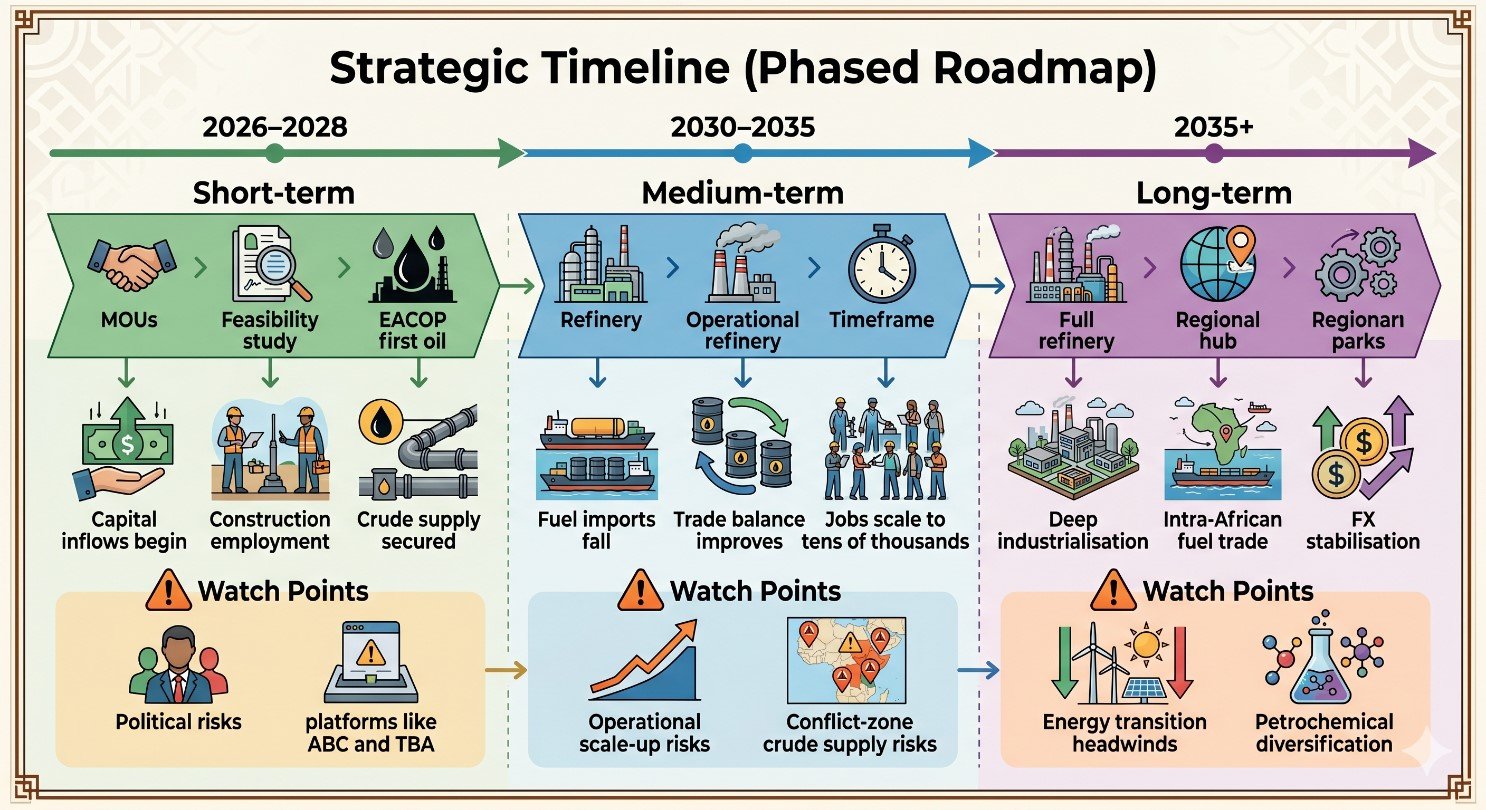
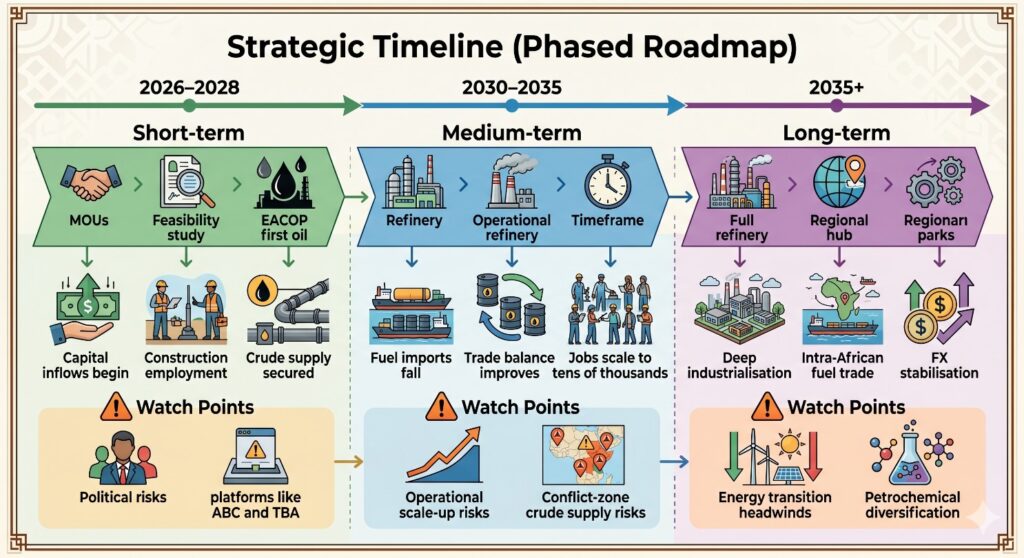
PHASED IMPACT TIMELINE
BOTTOM LINE
The Dangote East Africa Refinery is the most significant infrastructure commitment to African energy self-sufficiency since the Lekki groundbreaking. Three conditions that rarely coincide are currently present: demonstrated execution capability from the same developer, an 82 percent complete supply infrastructure, and political will across multiple sovereign governments. What remains absent — binding agreements, a governance structure, and a financing arrangement — represents both the project’s primary risk and its primary entry point for platforms, investors, and advisors who want to shape its architecture rather than respond to it after the fact.