
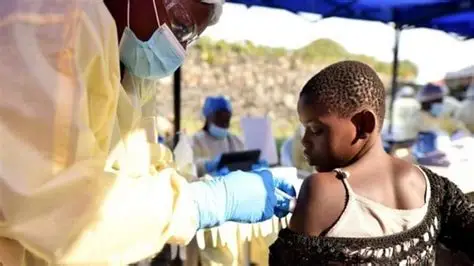
LAGOS — The United Nations is releasing approximately $60 million from its emergency fund to combat a rapidly escalating Ebola outbreak in the Democratic Republic of Congo (DRC), the UN aid chief announced Friday.
UN humanitarian chief Tom Fletcher confirmed the funding surge, adding that additional emergency staff are being deployed immediately to reinforce frontline operations in the country’s volatile northeastern territory.
The intervention targets the eastern Ituri province, where the World Health Organization recently declared the crisis a public health emergency of international concern due to severe regional transmission risks.
“We need to get ahead of this Ebola outbreak,” Fletcher stated. “These are tough operating environments for lifesaving work. We face conflict and high population movement.”
Medical experts revealed the outbreak is driven by the rare Bundibugyo strain. Because there is no approved vaccine or specific treatment for this variant, containment depends entirely on isolation and tracking.
Compounding the crisis, health officials believe the virus circulated undetected for two months before its official confirmation on May 15, allowing it to spread widely across mobile border populations.
The undetected spread has resulted in 160 suspected deaths out of 670 suspected cases. Health teams have already identified cross-border cases moving into intensive care units in neighbouring Uganda.
However, in Uganda authorities have quarantined over 100 persons following spread of the deadly Bundibugyo strain.
Uganda President Yoweri K Museveni, said on Thursday that everything is under control and no “cause for alarm,” with hope to keep the economy alive.
“Regarding Ebola, there is no cause for alarm. We are applying targeted measures and continuing to work scientifically to keep people safe while keeping our economy open.” President Museveni said in post on X (Twitter)
Logistics are severely hampered by local militia conflicts and a massive humanitarian crisis, with over 26 million Congolese facing acute food insecurity and compromised immune systems.
The UN allocation will finance an emergency logistics air bridge managed by the World Food Programme and MONUSCO to transport critical protective gear, water purification kits, and medical tents.
International partners are moving to bolster the response, with Norway contributing an additional 50 million kroner to the World Health Organization’s health contingencies fund on Friday.