
Africa’s total merchandise trade expanded 6.1 percent to $1.5 trillion in 2025, driven by resilient GDP growth across major regional economies despite a persistent $74 billion trade finance deficit.
The African Export-Import Bank’s 2026 trade report reveals continental GDP growth accelerated to 4.5 percent last year, up from 3.4 percent in 2024, outpacing global averages amid cooling inflation.
Total imports reached $781.5 billion against $685.2 billion in exports, leaving a $96.3 billion trade deficit. Meanwhile, intra-African trade grew 5.5 percent to hit a record $213.8 billion.
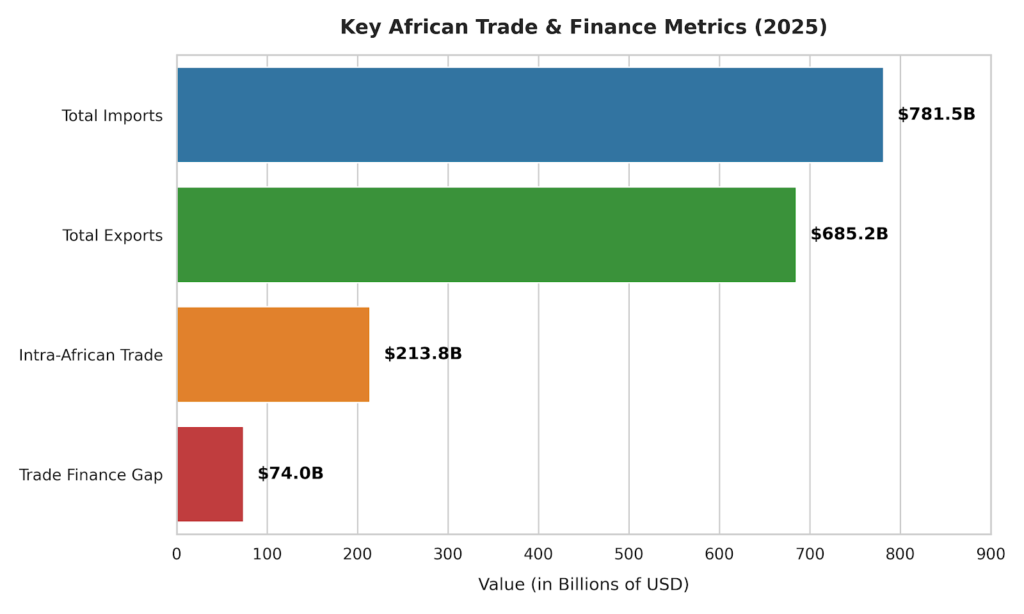
However, local exporters remain severely constrained by a restrictive $74 billion trade financing gap, heavily exacerbated by low foreign exchange liquidity and dwindling international correspondent banking relationships.
A stark divergence between official central bank monetary policy rates and commercial lending rates across the continent further weakened policy transmission, keeping private credit highly restrictive.
West Africa recorded significant volume shifts, propelled by Nigeria scaling up refined petroleum exports to neighboring nations, including Ghana, Cameroon, and Togo, reinforcing regional energy security.
To counter these systemic flaws, Afreximbank plans to double its intra-African trade finance allocations to $40 billion by the end of 2026, up from $17.5 billion disbursed in 2024.
Additionally, the Pan-African Payment and Settlement System is expanding rapidly, with over a dozen central banks connected to lower transaction fees and reduce heavy reliance on hard currencies. Africa’s total merch