
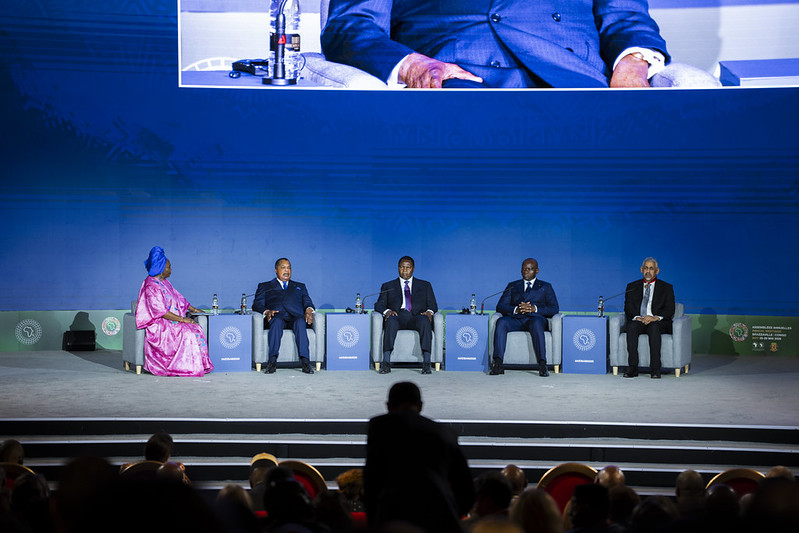
Africa’s economic growth is projected to slow slightly to 4.2% this year from 4.4% last year, as escalating geopolitical tensions in the Middle East drive up global fuel and food costs, the African Development Bank (AfDB) announced on Tuesday.
Despite the immediate headwinds, the 54-nation continent maintained its position as one of the world’s fastest-growing regions alongside Asia, comfortably outpacing Europe and Latin America during the same period, according to the bank’s annual African Economic Outlook report released at its annual meetings in Democratic republic of Congo (DRC). The AfDB expects growth to rebound strongly to 5.0% in 2027.
“Africa’s economies are projected to grow at 4.2 percent in 2026, moderating slightly from 4.4 percent in 2025, before rebounding to 4.4 percent in 2027.” AfDB stated
External Shocks and Supply Chain Disruptions
The slight deceleration comes as ongoing conflicts in the Middle East disrupt critical maritime trade routes, particularly through the Red Sea and the Strait of Hormuz. These disruptions have spiked shipping freights and insurance premiums, translating into imported inflation for basic commodities across Africa.
The AfDB warned that these conflict-driven supply chain shocks have kept average continental inflation sticky, with forecasts revised upward to 10.4% for this year. While this represents a notable drop from the bruising 13.7% average recorded last year, it continues to squeeze household purchasing power and strain national foreign exchange reserves.
“Persistent geopolitical tensions, alongside prolonged global supply chain and energy disruptions, could further strain fiscal and external balances through higher energy and fertilizer prices,” AfDB said.
Stark Regional Divergences
The headline continental growth figure masks a deeply fragmented macroeconomic landscape across Africa’s five regional economic blocs, largely determined by whether nations are net commodity importers or exporters:
| Region | Expected Growth | Key Economic Driver / Headwind |
| East Africa | Decreasing | Heavily impacted by high energy and fertilizer import costs due to Middle East supply shocks. |
| West Africa | 4.7% | Relatively stable (down from 4.8%), insulated by resilient agricultural output and infrastructure investments. |
| Central Africa | 3.8% | Expanding (up from 3.6%), buoyed by sustained high global crude oil prices benefiting oil exporters. |
| Southern Africa | 2.1% | Chronically subdued due to ongoing domestic power deficits and weaker mining output. |
The Call for Structural Reform and Domestic Capital
Beyond immediate growth tracking, the thematic anchor of this year’s report focuses on mobilizing Africa’s development financing amid a increasingly fragmented global landscape. The bank highlighted an annual financing deficit exceeding $1.3 trillion required for Africa to meet its Sustainable Development Goals.
With traditional Overseas Development Assistance (ODA) from Western nations dwindling, the AfDB urged member states to aggressively pivot toward domestic resource mobilization. The report estimates that deep structural reforms could unlock up to $1.43 trillion annually from internal savings pools. This includes optimizing tax collections to capture $469 billion and recovering $299 billion by eliminating public investment inefficiencies.
“Institutional investors, including pension funds, insurers and sovereign wealth funds, manage around $4 trillion in assets; yet less than 2.7 percent is allocated to infrastructure and productive sectors in Africa, underscoring significant untapped potential.” AfDB lamented.
Furthermore, while the market capitalization of Africa’s domestic stock markets has scaled to $1.2 trillion, the bank noted that activity remains highly concentrated in just four nations: South Africa, Egypt, Nigeria, and Morocco.
Long-Term Macroeconomic Outlook
Looking ahead, AfDB President Sidi Ould Tah emphasized that while Africa’s resilience in outpacing Western economies is commendable, a 4.2% growth rate is fundamentally insufficient for the continent’s demographic reality.
To effectively alleviate poverty, generate institutional employment, and absorb the continent’s rapidly expanding youth workforce, African economies must implement the structural changes necessary to unlock and sustain an annual growth threshold above 7% over the next several decades.