
Rule Breaker: Rebellious Leadership for the Future of Work
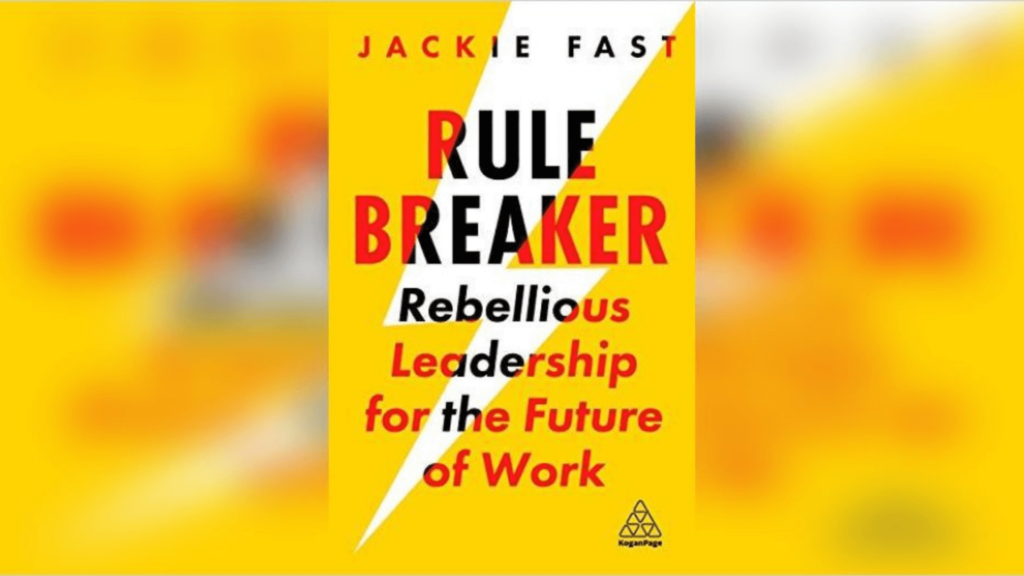
Author – Jackie Fast I think it is fitting this review coincides Hilda Baci breaking the Guinness World Record (GWR) for marathon cooking, beating the record set in 2019 by Lata Tondon. Cooking for 100 hours at a stretch is the kind of rebellious leadership that Jackie wrote about in this fascinating book. The first captivating sentence read in the book was in the introduction. Jackie says, “We are all obsessed with how the world is becoming vastly different from the world we used to know. But it is not the how part that you need to be preoccupied with. It is the why part of the shift that is particularly important to you. As Pastor Emmanuel Oleka, resident pastor of the Transforming Church Lagos Island said recently, “we do not have control over time and changes around us, but the ability to determine what happens overtime is within our grasp”. So, Jackie’s message is simple. New leadership requires breaking all the rules. While this assertion is rarely new, it is the simple way Jackie, using her personal experiences, breaks down the message that one will find most interesting. Reading the book, it becomes clear that breaking the rules is not for “exceptional people”. It can be learnt, cultivated, and become habitual. By continuously asking why, and in some cases, asking why not, Jackie demonstrated how she and the other examples in this terrific book have broken all the rules (certain assumptions and expectations) and achieving previously thought unachievable things. Jackie argued that we are now in a world with no boundaries, except those set by ourselves. Finally, a favourite topic in business and life – execution. Jackie showed in her book that because life is usually in repetitions and patterns, the ability to continuously improve and doing things better will make us exceptional.
Collapse and Recovery: How the Covid – 19 pandemic eroded human capital and what to do about it.

Authors: Nobert Schady, Alaka Holla, Shwetlena Sarbawal, Joana Silva, and Andres Yi Chang At the World Bank / International Monetary Fund (IMF) Spring Meeting 2023, this report was one of the most important released. While it is widely recognised that Covid – 19 pandemic impact on human capital was huge, little was known about the lingering consequences of the pandemic on young people. This report, using individual and household level data from low- and middle-income countries, articulated the likely consequences of the Covid – 19 pandemic on human capital and future implications for productivity, income growth, earnings, and inequalities if these losses are not reversed. The key element of the report is the dynamic impact of Covid – 19 pandemic on human capital, documenting how it affects human capital in the future. For instance, the report showed that “nearly 1 billion children missed a year or more of schooling and learned little, if anything, while schools were closed”. The report does not only examine what happened to the different sets of young people – childhood, adolescent, and early adulthood – critical ages of accumulation of human capital, but the dynamic effects of this impact many years to come. The implications are huge, affecting future productivities, earnings, income growth, and inequalities. Focus, therefore, should be on measures that helps to reverse the losses recorded during the pandemic. See more: https://www.worldbank.org/en/publication/human-capital/publication/collapse-recovery-how-covid-19-eroded-human-capital-and-what-to-do-about-it
ThinkBusiness Newsletter for 1st May 2023
1 May 2023 E kaaro o, Ututu Oma, Barka da Safiya – Good morning, happy workers day, and welcome to ThinkBusiness Nigeria. ThinkBusiness Nigeria newsletter provides essential strategic information on markets, macro, and political economy issues and dimensions that drives business and markets. It provides the highly mobile professional, investor, businessperson with the essential information and intelligence he or she needs to know. It summarises the markets, but providing insights on key shifts and changes and what they mean for your investments. It scans the entire Nigeria and foreign news landscape and distills what really matters from many noises around, and share them with you. In addition, ThinkBusiness Nigeria ensures you understand the factors driving those developments by providing required background and contexts. Strategy and personal development are important, so ThinkBusiness Nigeria also incorporates strategy for winning in business and life, drawing experiences from businesses, sports, history, life etc to give simple but powerful analogies about life and success and their underlying patterns. Markets % Change YTD (%) NGX ASI 52,403.51 0.32% 2.25% Brent Crude Oil 79.54 1.17% -7.93% I & E FX Window 462 0.12% -3.11% FX Parallel Market 739 0.27% 0.14% Gold 1992.64 0.19% 9.84% Cocoa 3,156.00 -0.47% 21.11% In partnership with National Headlines Global Headlines News Analysis – 2023 Workers’ Day: Not a smiling day for Nigerian Workers As we celebrate another Workers’ Day on May 1, 2023, with more or less zero improvement from the last celebration of Workers’ Day, one must wonder what exactly the point of the celebration is for the average Nigerian worker as working conditions for workers in Nigeria are far from ideal. Workers are faced with low wages and they are in a state of not having enough at almost all times. The minimum wage was raised by the federal government to N30,000 in 2018. This equates to N1,500 per day (20 working days in a month) and N187 per hour (for a regular 8-hour workday). It is significant to observe that the cost of living in all of these has climbed in recent years rather than decreased. For instance in 2018, the average inflation stood at 12.09%, a 50kg-bag of locally produced rice stood at N18,000. While the minimum wage has not changed in the last 5 years, inflation has risen to 22.04% as of March 2023, and a BusinessDay survey of some markets in Lagos found that a 50kg bag of locally parboiled rice now sells for N43,000, this is about 140% increase compared to 2018. The cost of living for average Nigeria worker is also exacerbated by the rise in rent, transportation, medical expenses and electricity, among others, and for most workers, the cost of living is about 5.3 times more than the average salary. Even as it may, many private organizations and government agencies, including 15 state governments, have yet to implement the N30,000 minimum wage. Abia, Bayelsa, Delta, Enugu, Nasarawa, Adamawa, Gombe, Niger, Borno, Sokoto, Anambra, Imo, Benue, Taraba, and Zamfara are among the states that have failed to implement the minimum wage. In the private sector for instance, OK foods industry worker took to the street to protest in 2021 about the unfair payment by the company. The mixing boys worked for 12 hours with a daily wage of N1,500, which amounted to N125 per hour which is far lower than the minimum wage per hour. The little that is been paid, though some below the minimum wage, workers still struggle to receive it as and when due. For instance in Abia state, health workers and teachers are currently owed between 10 months and 27 months’ salaries. Also, April 13, 2023, Ad hoc workers of the Plateau State College of Health Technology, protested over 45 months of unpaid salaries. ASUU in Taraba state earlier in April declared total and indefinite strike action hinged on government’s failure to pay earned academic allowances, promotion arrears, fractional payment of salaries to staff as well as unsettled staff pension and gratuity scheme. Due to the poor working condition and also inability of the workers take-home to actually take them home, many workers has sought to find a greener pasture elsewhere and Nigeria has lost more workers to other nation in recent years. Nigerian nationals emerged the second highest recipients of United Kingdom’s Worker Visas between in one year. The UK report on migration disclosed that the UK Government Worker Visa approvals for Nigerians in 2022 increased to 38,007 from 12,405 in 2021, a 206% increase in one year. Many of these migrant cited poor working condition and underpayment as the major reason. To make average worker in Nigeria happy, the Nigeria government must shift from the mentality of not prioritizing workers welfare to making it the first among most important policies. Investing in workers welfare by paying a living wage and provision of social security is a path that will lead to better days in every facet of Nigeria’s economy and development. Also, government should ensure that labour law implementation cut across the private and public and that worker across board are fairly rewarded. The Week Ahead Winning! My weekly thoughts on how you can “win” this week. The inspiration to “winning” this week comes from an interesting article and interview in the May – June 2023 edition of the Harvard Business Review (HBR) – pg 56 – 59. HBR spoke with Tim Simmons, the chief product officer of Sam’s Club, a membership only retailer with 600 stores in the US and Puerto Rico. According to interview, Sam’s Club has recorded a 43% increase in net sales after making six operational changes in their business. The company made six structural changes / elements to how it operates and serve its customers. Four of those changes were related to how they improved the conditions in which their workers now serve their customers, including changing workers specialty roles by broadening job roles, streamlined shifts and made them predictable and supporting workers lifestyle, used technology to support workers productivity and increased average pay by 31%. What is the take? Out of six