
African leaders and international partners have committed $27 billion in investment pledges at the Africa Forward Summit on Tuesday, to operationalize a new financial framework designed to slash borrowing costs and mobilize domestic savings.
The New African Financial Architecture for Development (NAFAD), spearheaded by the African Development Bank, received broad diplomatic backing as the primary vehicle to bridge the continent’s persistent $400 billion annual financing gap.
Central to the initiative is the scaling of African Trade & Investment Development Insurance (@ATI_ACA), establishing a pan-African guarantee mechanism to de-risk projects and attract a larger share of global institutional capital.
African Development Bank President Sidi Ould Tah emphasized that the continent is not capital-poor, holding nearly $4 trillion in domestic savings that currently lack the necessary “risk-transformation” instruments to fuel local industrialization.
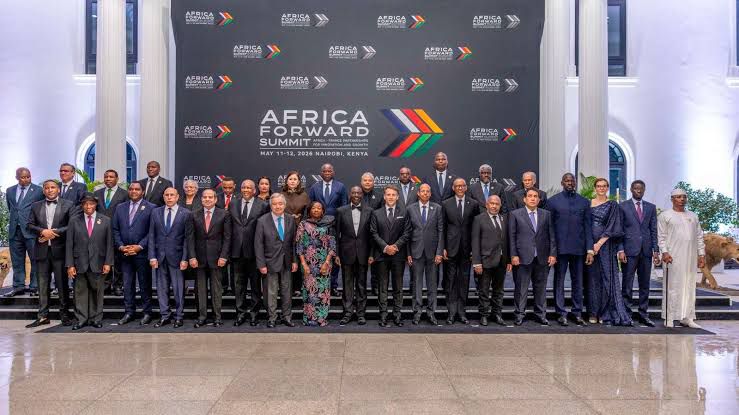
The summit, co-hosted by Kenya and France, drew over 30 heads of state and produced $27 billion in total commitments from French and African private and public sectors to fund critical developmental sectors.
The gathering in Kenya’s capital city, comes at the height of a fallout between France and its former colonies, mostly (Mali, Niger and Burkina Faso) in West Africa. The summit is the first hosting for France, outside Francophone countries.
The investment front, pledges focused heavily on energy transition, green industrialization, and digital infrastructure, with French President Emmanuel Macron noting that these investments aim to create 250,000 direct jobs across Africa and France.
Strategic agreements included a €300 million protocol between Proparco and Ecobank for agriculture, alongside bilateral deals for Kenyan rail modernization, signaling a shift toward sovereign-led, practical economic partnerships over traditional aid.
“New partnerships must not be built on dependency but on sovereign equality, not on aid or charity but on mutually beneficial investment, and not on extraction or exploitation but on win-win engagements,” President William Ruto said in his speech.
This coordinated architecture marks a milestone in African financial sovereignty, moving toward a system where domestic resources and home-grown guarantees dictate the pace of infrastructure development and small business growth.