
Nigeria’s Endless Refinery Repairs Continue After $5.3 Billion Spent in 27 Years
For nearly three decades, Nigeria’s state refineries have been less of an industrial asset and more of a financial sinkhole. Since 1999, successive administrations have poured over $5.3 billion into “Turnaround Maintenance” (TAM), yet the taps remain dry. The legacy of waste is staggering. Under the Obasanjo era, $800 million vanished with little impact. The Yar’Adua and Jonathan years saw another $1.6 billion committed, while the Buhari administration approved a massive $2.9 billion. Despite these injections, the Port Harcourt refinery—declared operational in late 2024—shuttered again within six months. This history of failure is currently under the microscope of the Economic and Financial Crimes Commission (EFCC). The agency is probing an alleged $7.2 billion fraud linked to these failed rehabilitations. High-ranking former officials, including ex-Group CEO Mele Kyari, former Chief Financial Officer Umar Ajiya Isa, and past refinery MDs like Ahmed Adamu Dikko and Ibrahim Onoja, have faced questioning over the disbursement of funds that produced no fuel. Current NNPC GCEO, Bashir Bayo Ojulari, is now attempting to pivot away from this culture of contractor-led waste. On April 30th, The NNPC signed a Memorandum of Understanding with Chinese giants Sanjiang Chemical Company and Xinganchen Industrial Park to introduce a Technical Equity Partnership. Unlike the old “fix-and-fail” contracts, this model requires the Chinese partners to hold equity. Their profits are tied to actual production, not just showing up for repairs. By transferring operational risk to private hands, Ojulari hopes to transform the NNPC from a “refinery racket” into a commercial entity. For a nation that has spent 27 years importing its own prosperity at a high cost to the Naira, this shift is more than a policy change—it is a desperate attempt to plug a multi-billion dollar drainpipe that has bled the treasury for a long time. However, recent assessments of the MoU shows both Chinese companies lack the capacity to revive a refinery, as their past records shows they’ve never actually rehabilitated any crude oil refinery—such as the Warri, portharcourt refinery. The first partner in the MoU, Sanjiang Chemical Company limited, is a privately owned manufacturer in the chemical sector, with core expertise in downstream petrochemical derivatives rather than upstream crude oil refining. Conversely, Xingcheng industrial park and management co. Ltd, operates as a real estate and facility management firm; with no records in petroleum engineering or crude oil refining. Whether the flares at Port Harcourt and Warri will finally stay lit remains the ultimate test of this new strategy.
Nigeria turns to Chinese partners to revive state-owned refineries
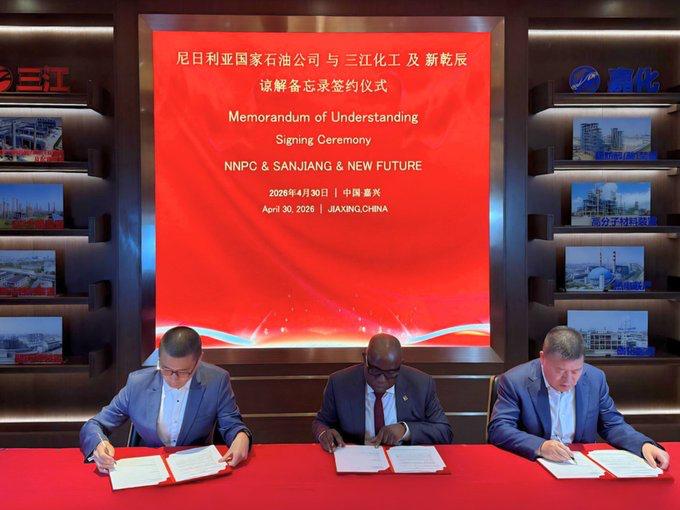
Nigeria’s state oil firm NNPC Ltd. has signed a preliminary agreement with two Chinese companies to complete rehabilitation and manage operations at the Port Harcourt and Warri refineries. The memorandum of understanding targets a technical equity partnership with Sanjiang Chemical Company and Xinganchen Industrial Park to ensure sustainable performance through private-sector discipline and investment. Group CEO Bashir Bayo Ojulari said the deal followed six months of negotiations and aims to restart the long-dormant facilities while expanding their petrochemical and gas-processing capacities. The move marks a departure from traditional rehabilitation contracts, shifting toward a model where partners share equity and operational risk to improve accountability and long-term profitability. Nigeria has spent over $2.5 billion on refinery maintenance since 2021, yet the state-owned plants have remained largely moribund, forcing the country to rely heavily on fuel imports until the emergence of the Dangote refinery in late 2023. The collaboration includes plans to upgrade both facilities to meet cleaner energy standards and develop industrial hubs co-located within the refinery complexes to boost domestic production. “All parties recognise mutually beneficial opportunities for the development and long-term sustainable profitability of NNPC’s refining assets in Nigeria, and the collective weight required for success,” Ojulari noted in a statement on Sunday. Definite arrangements remain subject to regulatory approvals, but the partnership represents a critical step in the government’s renewed push to achieve domestic energy self-sufficiency.
Nigeria: NNPC Limited Reaches Five-Year Oil Production High of 1.71 Million BPD
LAGOS — The Nigeria National Petroleum Company Limited (NNPCL) has achieved a five-year production peak of 1.71 million barrels per day, according to its mandate report for the period ending April 2026. The company’s exploration arm, NEPL, also recorded a historic peak output of 365,000 barrels per day in December 2025, signaling a robust recovery in upstream operations. This growth follows the resolution of the long-standing OPL 245 dispute, which has been successfully converted into new Production Sharing Contracts for deepwater gas resources. Financially, the firm resumed full monthly remittances to the Federation Account in July 2025 and hosted its inaugural earnings call in November to improve corporate transparency. The report confirms NNPC consolidated a 7.25% equity stake in the Dangote Refinery, sustained by a strategic “crude-for-naira” supply program to ensure national energy security. In the gas sector, the firm completed the AKK River Niger crossing in July 2025 and commissioned the ANOH gas processing plant to enhance domestic supply. Total gas supply reached 7.5 billion standard cubic feet per day, supported by new distribution deals with major industrial players like Dangote Cement and CNG Ibese. The company also launched the “Fit4Future” initiative, onboarding 1,000 new staff members to drive a major internal reorganization focused on profitability and execution excellence. A new Incorporated Joint Venture model was introduced for refineries, aiming to create a sustainable structure where each facility can self-finance and operate competitively. This performance follows Nigeria’s recent struggles with oil theft and pipeline vandalism, which had previously dragged production below 1.2 million barrels per day in 2024. “Over the past year, we have delivered steady progress against our mandate, with measurable results across production, financial performance, infrastructure, and organisational culture.” Said Bayo Ojulari, NNPCL Group CEO on Sunday. Analysts suggest that maintaining this 1.7 million bpd momentum is vital for the Federal Government’s 2026 budget assumptions and stabilizing the volatile Naira exchange rate.
Nigeria’s oil company remits record N1.8tn to federation account following policy shift
LAGOS – The Nigerian National Petroleum Company Limited (NNPC Ltd) remitted a record N1.804 trillion (approx. $1.31 billion) to the Federation Account in February 2026, marking a staggering 148% increase from the N726 billion ($529 million) remitted in January. According to the company’s latest Monthly Report Summary, the surge in fiscal performance follows the implementation of Executive Order 9, signed by President Bola Tinubu in mid-February. The directive overhauled the oil revenue remittance framework, mandating a direct payment model and curbing long-standing deductions previously retained by the state-owned oil firm. The report highlights a significant strengthening of the Federation’s revenue base, as total revenue for the month rose to N2.68 trillion ($1.95 billion), up from N2.57 trillion ($1.87 billion) in the preceding month. Profit after tax (PAT) for February also showed improvement, reaching N136 billion ($99.1 million). The Impact of Executive Order 9 The primary catalyst for the nearly N1.1 trillion ($801 million) month-on-month increase is the suspension of specific fees NNPC Ltd formerly deducted “at source.” Under the new framework, the company has ceased the collection of: By eliminating these retentions, the Federation now receives 100% of PSC profit oil, a sharp departure from the previous structure where nearly two-thirds of potential revenue was diverted toward operational and exploration costs. While the financial spike was largely driven by structural reforms, operational data remained relatively stable. Crude oil and condensate production averaged 1.51 million barrels per day (mbpd) in February. Although production slightly dipped from January’s levels due to localized evacuation constraints, the “cleanup” of the remittance pipeline ensured that the resulting revenue reached government coffers more efficiently. Industry analysts suggest the new direct remittance model restores constitutional compliance and provides much-needed liquidity for the federal, state, and local governments.With the Federation Account Allocation Committee (FAAC) expected to distribute these record funds later this month, the February performance marks a pivotal moment in the government’s push for transparency and increased non-debt revenue.