
Two years after American forces completed their withdrawal from Niger, Washington is trying to return through finance rather than force.
The U.S. International Development Finance Corporation has approved a debt facility of up to $414.2 million for Canadian miner Global Atomic’s Dasa uranium project in northern Niger.
The money has not been released. The DFC board’s decision is a financing milestone, not a completed loan, and it comes after the 2023 coup and the 2024 expulsion of roughly 1,000 U.S. troops from bases in Niamey and Agadez, including the drone hub at Air Base 201. If the loan closes, DFC will also receive common share purchase warrants in Global Atomic. The warrant terms have not been set.
For U.S. officials, the attraction is straightforward. Uranium was added to America’s critical minerals list in 2025. Nuclear utilities want supply that is not tied to rival governments. Dasa, about 105 kilometers south of Arlit, is the vehicle Global Atomic is offering them.
What the mine is, and what it is not
Global Atomic calls Dasa Africa’s highest-grade uranium project now under development and the highest-grade deposit outside Canada’s Athabasca Basin. Its 2024 feasibility study projects 68.1 million pounds of uranium oxide over a mine life of about 23 years, from reserves of 73 million pounds. Those figures are study estimates, not production.
The company has signed offtake contracts covering about 11% of that mine plan. Most of the contracted volume is with North American utilities; a smaller European contract sits alongside them. The rest of the planned output is still uncommitted. No uranium supply agreement is attached to the DFC facility itself.
The timing matters in Niamey. Relations between the junta and French state-backed miner Orano have collapsed into nationalizations, revoked titles, and international arbitration. Dasa is one of the few large Western mining projects still advancing.
The local company
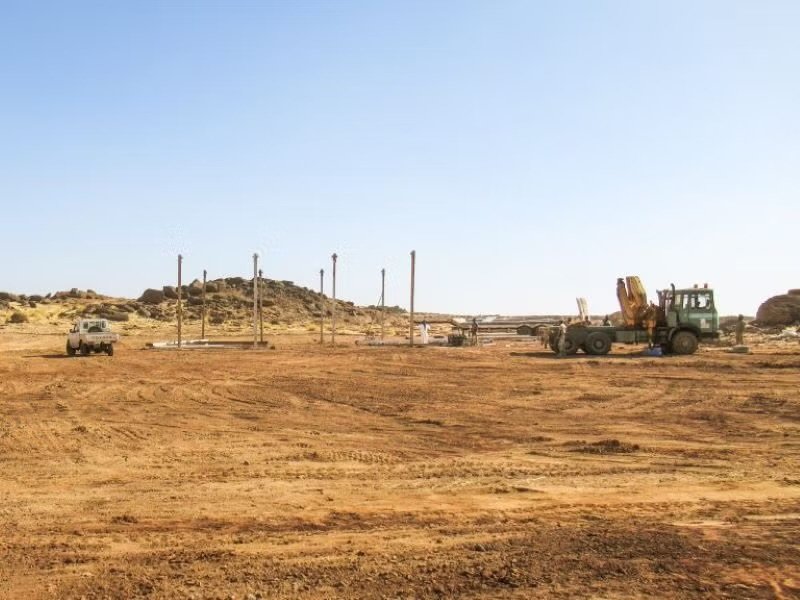
The mine is held through Société Minière de Dasa S.A., or SOMIDA. Global Atomic owns 80%. The Nigerien state owns 20%: the 10% free-carried interest required by the mining code, plus another 10% that the government agreed to fund. Hundreds of people are already working on site. Government figures around a May visit put the number near 700. Underground development has reached the ore zone, and work on the processing plant is under way.
“The Dasa Uranium Mine is the largest highest-grade uranium mine in Africa and is scheduled to begin commercial production H2 2028,” Global Atomic president and CEO Stephen Roman said.
What still has to happen
The $414.2 million facility remains contingent on conditions Global Atomic itself listed: a viable route to export yellowcake; extensions of the mining convention and permit on terms that match the life of the loan; government assurances on loan-repayment approvals; a direct agreement with Niamey; and final loan documents with the DFC. The company has cautioned that there is no assurance those conditions will be met on time, or at all.
The hardest of those problems is physical. Niger is landlocked, and the old export path through Benin to Cotonou has been disrupted since the coup. Jihadist violence still threatens roads in the Sahel.
Project planners have looked at other corridors, including a northern route through Algeria and across the Sahara. That option has been described as promising. It is not an approved export system.
The troop withdrawal ended one American presence in Niger. This would be a narrower one: a development-finance stake in a Canadian-run mine the military junta still partly owns.
However, the facility can still fall apart on the export route, the permits, or Niamey’s guarantees.