

Nigerian businesses should not expect cheaper bank loans in the coming weeks after the Central Bank reset the Monetary Policy Rate to 23% on Tuesday. Economists at a Wednesday webinar hosted by Macrostrat Nigeria Limited said the cut was a policy signal, not an immediate drop in the cost or supply of credit to manufacturers, traders and SMEs.
The Monetary Policy Committee, at its 307th meeting on 21 and 22 September, reset the MPR from 26.50% to 23.00%, a 350 basis-point move that was larger than most analysts had priced. The consensus before the meeting was a hold, or at most a 50 to 100 basis-point trim.
Governor Olayemi Cardoso did not present the decision as the start of a cheap-money cycle. He called it an operational reset. Market rates in the interbank market and on short-term government paper had already fallen below the old 26.50% benchmark, weakening the MPR as a policy signal. The corridor around the new rate was set at +50/-300 basis points, putting the standing lending facility at 23.50% and the standing deposit facility at 20%. The Cash Reserve Ratio was left at 45% for deposit money banks, 16% for merchant banks and 75% on non-TSA public-sector deposits. Cardoso said that package does not change the Bank’s underlying stance.
That is the point businesses need to separate. Inflation eased to 15.39% in August. The official rate is now 23%. Neither figure is the rate most firms will pay.
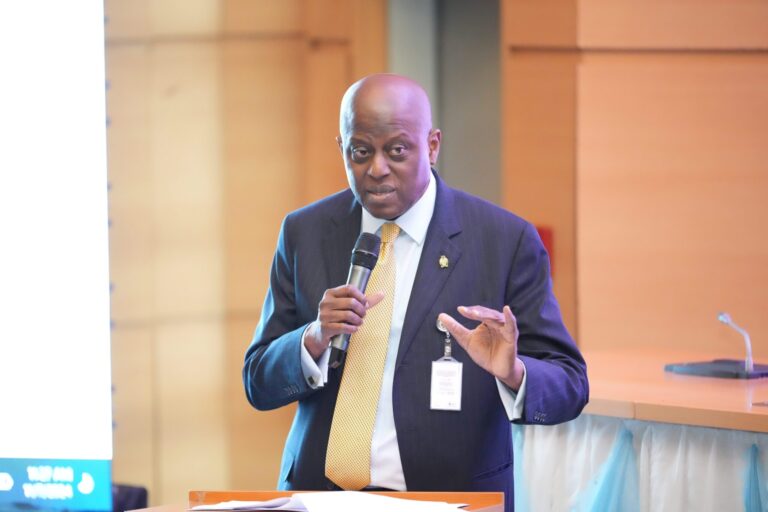
Speaking at the webinar, The Balancing Act: Navigating the CBN’s September MPC Decision for Real Sector Growth and Economic Resilience, Professor Emmanuel Nwosu of the University of Nigeria, Nsukka, said the transmission from policy rate to bank lending in Nigeria is slow, especially for smaller borrowers.
“We are looking at transmission lag of at least 6 to 12 months,” he said. “This is just a signal. First it will have to translate to low cost of lending. This has not happened… So it’s not going to be fast.”
He called on SMEs to use this opportunity to tighten their financial records and restructure their outstanding debts instead of borrowing new loans.
Dr Faith Iyoha Senior Economist at Nigerian Economic Forum (NESG) said the Committee changed the advertised price of liquidity but not the volume banks can lend.
“You’ve reduced the rate to track domestic economic reality because our market rates have been below the MPR. And then you’re just recalibrating,” she said. “They’ve just signaled a change in market rate without changing liquidity or credit availability. Banks still have only about 25% of their fund to give out as credit. And if credit is not available, you can hardly do anything with the cost.”
Even if funding costs ease later, banks still have a choice. They can lend to a factory with unstable power and thin records, or buy Treasury bills, bonds and commercial paper.
Professor Adeola Adenikinju, a former MPC member, and Dr Iyoha both said that bias has not gone away.
“If it is still more attractive, then the finance will not go to the real sector. It will remain in short term instrument,” Dr Iyoha said. “This has not significantly changed anything.”
Short-term government yields had already fallen below the old MPR. That is why the CBN said it had to reset the benchmark. If that paper still looks safer, the money stays in the market.
Dr Ogho Okiti of ThinkBusiness Africa and Professor Comfort Amire of Crawford University said the bigger squeeze on firms is still diesel, power, haulage, bad roads and FX.
“No matter how lower the interest rate is, it cannot solve the problem that comes from high production costs,” Professor Amire said. “It is the structural reforms that can make it possible to produce more with that particular money.”
For operators, the practical reading is straightforward. Do not take on new debt because the headline rate fell. Keep cash close. If you already sit on expensive legacy facilities, use the shift in tone to reopen talks with your bank. Clean up your records; when lenders do loosen, they will look first at MSMEs with books they can underwrite.
The Committee meets again on 23 and 24 November. What happens to the CRR, prime lending rates and T-bill yields will matter more than 23% on this week’s communiqué. Cardoso said the Bank would stay restrictive for as long as it had to. Until banks have more room to lend, the reset corrects the benchmark. It does not, by itself, cheapen credit.