
Africa is facing a changing global trade environment as major economies increasingly use tariffs, market access, geopolitical alignment and strategic partnerships to advance their economic interests. The suspension of South Africa and Rwanda from the African Growth and Opportunity Act (AGOA) trade programme by the United States from January 2027 is both the latest development and part of a wider shift in Africa’s trade relations with the rest of the world.
On November 2, a day before the US midterm elections and two days before municipal elections in South Africa, US Trade Secretary Jamieson Greer announced to Congress that South Africa and Rwanda would be excluded from trading under AGOA terms from next year. According to the statement, the decision followed the annual review of Sub-Saharan African countries’ eligibility for the AGOA trade preference programme, which found that Pretoria and Kigali were engaging in practices inconsistent with its eligibility criteria.
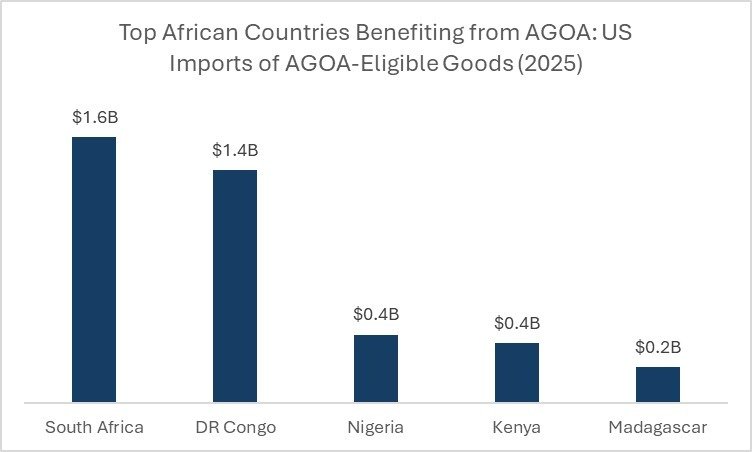
For Rwanda, the report cited concerns around the rule of law, human rights and corruption, while South Africa’s exclusion was linked to concerns about national security and geopolitical alignment. The suspension means that South Africa stands to lose export access under AGOA terms estimated at $1.7 billion, while Rwanda’s exports under the programme are estimated at $1.7 million, representing about 4% of its trade with the US.
For both countries, and Africa more broadly, the suspension is more symbolic than an immediate trade devastation. At its peak, Africa’s exports under AGOA reached $96 billion in 2011, heavily skewed by crude oil exports from Nigeria and Angola, which accounted for 80–90% of AGOA exports. Following the US shale boom from 2012, demand for African crude oil declined. South Africa’s exports under the programme peaked at about $4 billion in 2024 but fell sharply in 2025 to $1.7 billion after the US imposed automotive and sector-specific tariffs.
When AGOA was signed into law by President Bill Clinton in May 2000, proponents believed it would serve as a platform for African industrialisation and the transition to higher-income economies. The programme, however, never achieved anything close to that ambition.
AGOA is a Symptom of Broader Shifts in Africa and Global Trade
The changes in Africa’s trade relations with the rest of the world are not isolated. They are taking place amidst wider changes in global trade relations, shaped by geopolitical fragmentation, discriminatory tariff measures, growing trade between countries of the Global South, and the race towards clean energy, which is driving demand for the materials used in the industries producing it.
Outside the African Continental Free Trade Area (AfCFTA), where African countries are pushing for greater economic integration, they are largely responding to, and on the receiving end of, global trade policies shaped by these developments.
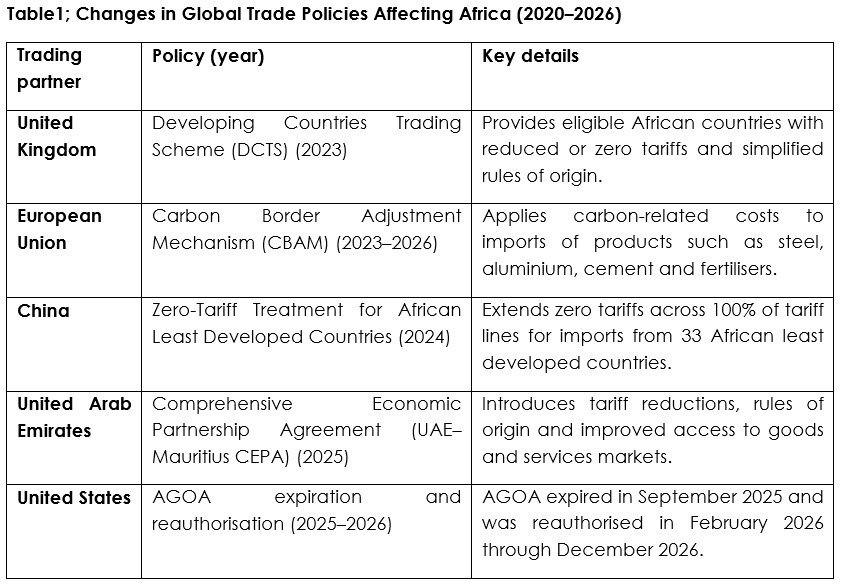
For instance, in May this year, China established 100% duty-free tariff lines for 53 African countries and introduced fast-track customs clearance for African agricultural products, while doubling down on efforts to ensure uninterrupted supply chains for minerals such as cobalt, lithium and copper.
Following Brexit, the United Kingdom established the Developing Countries Trading Scheme (DCTS) to replace the European Union’s Generalised Scheme of Preferences for 37 African nations. It has also signed Economic Partnership Agreements (EPAs) with regional economic blocs, including the Southern African Customs Union (SACU) and the East African Community (EAC).
Nonetheless, the largest beneficiary of these changes, as reflected in historical and more recent trade patterns between Africa and the rest of the world, has been China. Ten years ago, in 2016, China’s total trade with Africa stood at $149 billion, compared with $348 billion in 2025. With a trade deficit estimated at $100 billion, policymakers hope that duty-free exports into China will help narrow the gap.
These developments point to a more competitive and increasingly fragmented global trading system, where access to markets is shaped not only by commercial considerations but also by strategic interests and political relationships.
South Africa and Rwanda: Different Levels of Exposure
For more than two decades, eligible countries in Sub-Saharan Africa have been able to export thousands of products to the United States without paying import duties under AGOA. The withdrawal of South Africa and Rwanda from the programme will remove this advantage, although the implications for both countries are quite different.
South Africa has been one of the major beneficiaries of AGOA, particularly through its automotive, agricultural and manufacturing exports. In 2025, South African goods receiving AGOA duty-free treatment were valued at approximately $1.7 billion, accounting for about 32% of total US imports under the programme. The automotive industry is particularly exposed, with vehicles and components accounting for approximately 64% of South Africa’s AGOA-eligible exports in 2024. The withdrawal will add to existing pressures from US automotive tariffs and growing competition, potentially affecting production, investment and jobs across the value chain.
For Rwanda, the immediate trade exposure is considerably smaller. The country had already lost preferential treatment for apparel exports in 2018 following a dispute with Washington over restrictions on imports of second-hand clothing. In 2025, only around 4% of Rwandan goods entering the US claimed AGOA benefits. While the direct tariff impact may therefore be limited, the withdrawal represents a strategic setback for Rwanda’s efforts to attract export-oriented investment and diversify its access to international markets.
The distinction is important. For South Africa, the immediate concern is the competitiveness of established export industries. For Rwanda, it is the loss of a trade incentive that could support future export growth and investment.
Beyond Preferential Access
The loss of AGOA benefits by South Africa and Rwanda reinforces a fundamental reality for African economies: access to international markets through trade concessions is a conditional instrument of foreign policy, not a permanent commercial guarantee. While AGOA was established in 2000 to promote African trade and development, its latest application demonstrates how market access can also be shaped by national security, foreign policy and domestic political considerations.
For African economies, the priority must be to turn access to global markets into lasting productive capacity. This requires investment in manufacturing, stronger regional supply chains, improved trade infrastructure and deeper regional integration through the AfCFTA. AGOA’s rules of origin also highlight the importance of regional production networks, as the exclusion of one country can affect suppliers and manufacturers across neighbouring economies.
Ultimately, Africa must move beyond dependence on preferential access and build the capacity to compete in an increasingly changing global trade environment. The challenge is not simply to secure access to international markets, but to strengthen the productive base, trade relationships and economic partnerships that allow African countries to negotiate and compete from a position of strength.
Africa and China Trade: Comparing the Numbers: 10 Years Ago vs. Today
| Metric | 10 Years Ago (2016) | Today (Current 2025) | % Change |
| Total Bilateral Trade | $149.2 billion | $348.08 billion | +133% |
| Chinese Exports to Africa | $92.1 billion | $225.03 billion | +144% |
| African Exports to China | $57.1 billion | $123.05 billion | +115% |
| Africa’s Trade Deficit | $35.0 billion | $102.01 billion | +191% |