
Beyond Bank Loans: The Rise of Nigeria’s Alternative Corporate Credit Market

With bank lending rates remaining prohibitively expensive, an increasing number of Nigerian companies are turning to the domestic debt market for financing. Through commercial paper issuances, businesses are accessing institutional investors at rates potentially 300–900 basis points below conventional bank lending rates. The development signals a shift in corporate financing, with implications for banking competition, capital market development and the future of business growth in Nigeria and across Africa.
At its September 2026 meeting, the Central Bank of Nigeria’s Monetary Policy Committee (MPC) reduced the Monetary Policy Rate (MPR), the benchmark interest rate, by 350 basis points to 23%, its first adjustment since February. The decision followed an extended period of tight monetary conditions, during which the MPR had remained as high as 27.5%. Despite the latest reduction, the cost of conventional bank borrowing remains elevated, with some lending rates exceeding 30% and reaching approximately 34.5%.
To avoid the prohibitive cost of capital, particularly for working capital requirements, businesses have increasingly turned to commercial papers (CPs). Rather than relying exclusively on bank credit, companies are accessing capital directly from investors through the domestic debt market. According to credit analysts familiar with the market, the financing advantage can range between 300 and 900 basis points, depending on the issuer, tenor and terms of the facility.
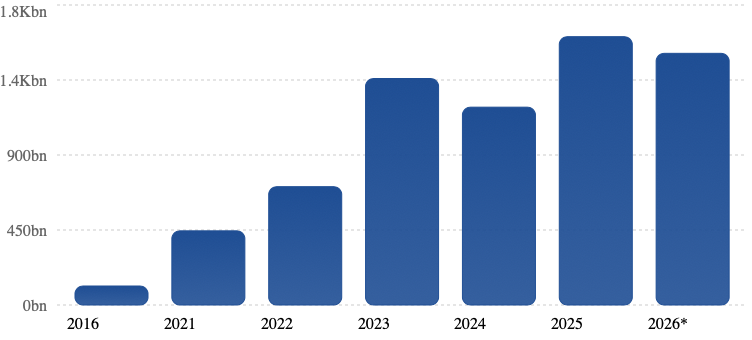
The most recent data from the Nigerian Exchange’s (NGX) Q3 2026 Commercial Paper Market Report, published in October, shows that businesses raised ₦506.4 billion across 46 new series from 28 issuers in the third quarter. This brought total issuance for the first nine months of the year to ₦1.51 trillion, across 131 series from 60 issuers.
The figures underscore the growing importance of commercial papers as an alternative source of corporate financing in Nigeria. They also point to a broader development in the country’s debt and capital markets, as businesses increasingly explore financing options beyond conventional bank lending.
The high cost of bank credit
On the face of it, the growth in commercial paper issuance is being driven largely by the high cost of bank borrowing, itself a consequence of the CBN’s aggressive monetary tightening cycle.
The restrictive monetary environment significantly increased the cost of credit for businesses. According to the CBN’s weekly bank lending rate data, the average maximum lending rate stood at approximately 34.5% in May 2026. By comparison, disclosed commercial paper rates during the period ranged from approximately 17% to 24.5%, with an average of around 22.5%.
Although these rates are not strictly comparable across different borrowers, tenors and transaction costs, the difference illustrates why commercial papers have become increasingly attractive to companies seeking short-term funding.
The trend is also reflected in the market’s growth over the past few years. Nigerian companies raised approximately ₦1.61 trillion through commercial papers in 2025, representing a 40% increase over the approximately ₦1.15 trillion recorded in 2024.
A changing corporate debt market
Nigeria’s commercial paper market has undergone a substantial transformation over the past decade. What was once a relatively small funding channel, used predominantly by financial institutions and large corporations, has become an increasingly important source of short-term financing for businesses.
Data from the Securities and Exchange Commission’s Nigerian Capital Market Master Plan shows that commercial paper issuance grew from ₦115 billion in 2016 to ₦756 billion in 2020. The sectoral composition in 2020 was led by financial services, which accounted for 38% of proceeds raised, followed by consumer goods at 21%, with other sectors accounting for the remaining 41%.

The composition of issuers and sectors has continued to evolve. The NGX Q3 2026 report shows that agriculture accounted for the largest share of quarterly issuance, raising ₦226.2 billion, or approximately 45% of the total. Oil and gas followed with ₦106 billion, while financial services accounted for ₦65 billion. Information and communications technology also featured prominently, alongside other sectors.
The increasing participation of agriculture, oil and gas, ICT, construction, real estate and other businesses suggests that commercial papers are becoming a broader corporate financing instrument, rather than remaining concentrated in a few traditional sectors.
The change is particularly significant for the productive economy. Agricultural businesses require financing for commodity procurement, processing and distribution, while manufacturers and distributors need substantial working capital to sustain inventories and operations. Commercial papers are providing another channel through which these businesses can meet their short-term financing needs.
The emergence of new corporate borrowers
Another important development is the growing participation of unlisted companies and businesses outside the traditional blue-chip corporate category. Unlike equity issuance, commercial paper issuance does not require a company to be listed on the Nigerian Exchange. Qualifying private companies can access the debt market, provided they satisfy the relevant regulatory, financial reporting and credit-rating requirements.
Some of the companies accessing the market in 2026 include Pivot Integrated Energy Services, Sunny Owo Ventures, Payaza Africa, Johnvents Industries and Carlodian Limited. Others include Sunbeth Global Concepts, SKLD Integrated Services, Sycamore Integrated Solutions, C&I Leasing, HillCrest Agro-Allied Industries and ARCO Worldwide Services.
The growing presence of these companies points to the possibility of a wider corporate debt market, one that is not exclusively dependent on established publicly listed businesses.
However, this development should be viewed within the broader context of African capital market financing. The OECD’s Africa Capital Markets Report 2026, released in November, finds that access to market-based debt financing across the continent remains concentrated among larger corporates, with smaller businesses continuing to depend heavily on direct bank lending.
The OECD estimates that outstanding African corporate debt amounted to $211 billion at the end of 2025, with syndicated loans accounting for 81% of the total. Corporate bond markets remain relatively small, while access to alternative financing is still limited for smaller businesses.
Nigeria’s commercial paper market may therefore offer an interesting example of how domestic debt markets can gradually expand access to corporate financing, although the extent to which mid-sized businesses account for total issuance still requires further investigation.
The investor appetite behind the growth
The expansion of commercial papers is not driven solely by businesses seeking cheaper credit. There is also a supply-side dimension.
Pension fund administrators, asset managers, insurance companies and other institutional investors are looking for attractive returns and opportunities to diversify their portfolios. Commercial papers provide exposure to corporate credit, relatively short investment tenors and yields that can be attractive compared with alternative fixed-income instruments.
For investors, they offer an opportunity to diversify beyond government securities and other conventional fixed-income assets. For companies, they provide access to a pool of institutional capital without necessarily having to negotiate conventional bank credit facilities.
The growth of Nigeria’s institutional investment industry, alongside the development of issuing houses, credit-rating agencies, trustees and other capital market intermediaries, has helped create the infrastructure required to support this activity.
This relationship between corporate demand for funding and institutional demand for investment opportunities is an important part of the commercial paper market’s expansion.
The working capital imperative
Underlying the growth in commercial paper issuance is the increasing need for working capital across the Nigerian economy. Inflation and rising operating costs have significantly increased the amount of money businesses require to maintain their operations. Manufacturers need more capital to procure raw materials, distributors require larger sums to finance inventories, and agricultural businesses need funding for procurement, processing and distribution.
For companies operating in fast-moving consumer goods, manufacturing, agriculture and distribution, the ability to secure short-term financing at competitive rates can make a significant difference to operating margins and cash flow.
Commercial papers are particularly suited to these requirements because they provide short-term liquidity without necessarily requiring companies to take on longer-term bank facilities.
They may also offer an alternative to some secured bank facilities, although commercial papers are not automatically collateral-free. Their structure, credit enhancement and guarantees depend on the issuer’s creditworthiness and the requirements of the particular issuance.