
Africa’s Capital Markets Are Growing, but Struggle to Mobilise Domestic Wealth, Says OECD
Africa’s capital markets recorded remarkable growth in 2025, with equity market capitalisation surging by 49%, more than twice the global growth rate of 21%. Yet rising valuations have not translated into a comparable increase in new investment flowing to businesses, exposing a deeper weakness in the continent’s financial systems.
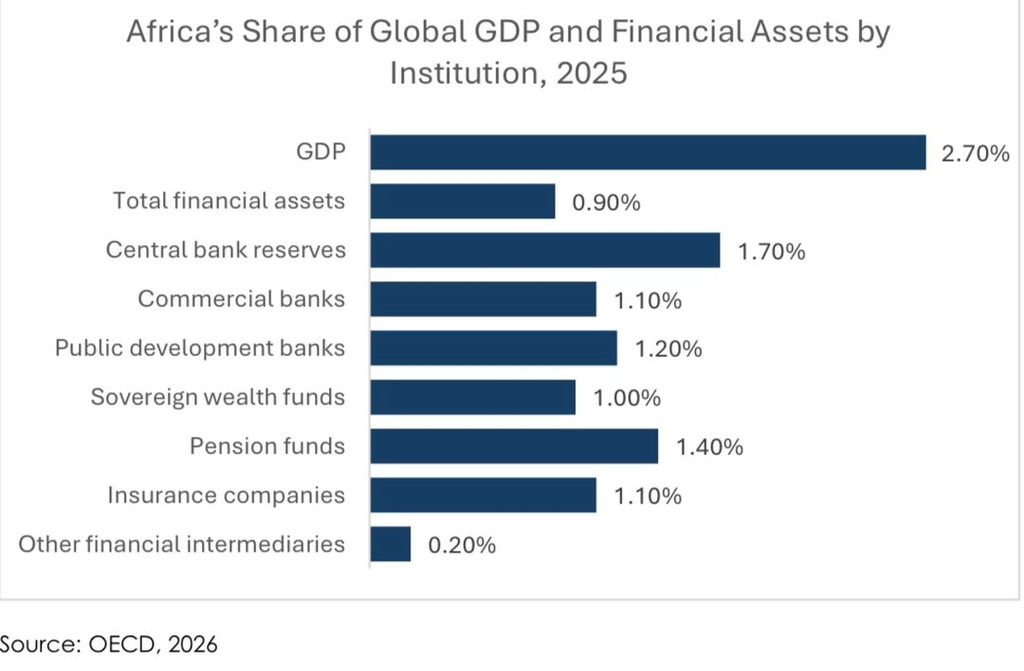
According to the OECD, Africa holds USD 4.4 trillion in domestic capital pools, comprising resources held by banks, pension funds, insurance companies, sovereign wealth funds and other financial institutions. Despite contributing 2.7% of global GDP, the continent accounts for just 0.9% of global financial assets. Much of this wealth remains insufficiently channelled into productive investment.
Institutional savings are heavily concentrated in government securities, while weak corporate debt markets, low insurance penetration and limited pension coverage constrain long-term financing for businesses. The result is a disconnect between the resources available within African economies and the capital reaching enterprises that could drive growth, create jobs and support investment.
Closing this gap requires more than expanding stock markets. It calls for stronger institutions and financial instruments capable of connecting domestic savings with productive investment opportunities.
Strong Market Growth, Limited Access to Capital
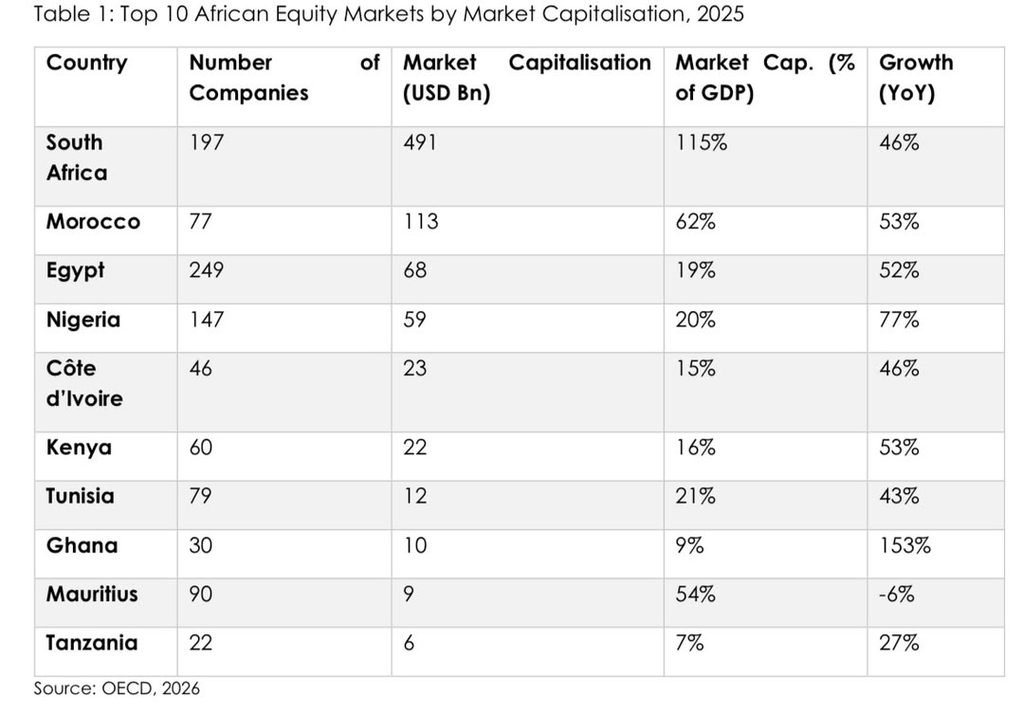
Africa’s equity markets outperformed global and emerging-market peers in 2025, but market activity remains concentrated in a handful of countries. South Africa, Morocco, Egypt and Nigeria accounted for 88% of the continent’s total equity market capitalisation. South Africa alone represented USD 491 billion, compared with USD 59 billion in Nigeria.
However, rising valuations have not been matched by a comparable increase in new listings. Only seven companies raised USD 1 billion through initial public offerings (IPOs) in 2025, representing less than 0.7% of the USD 152.8 billion raised globally. By contrast, 38 already-listed companies raised USD 5.7 billion through secondary equity offerings, with South African companies accounting for approximately 75% of the proceeds. This suggests that Africa’s equity market growth has largely benefited established companies, while new businesses across much of the continent continue to struggle to access public capital.
Locked out of equity markets, African businesses face another hurdle when seeking debt financing. According to the OECD, the continent’s corporate debt market stood at just USD 211 billion at the end of 2025, representing 0.3% of the global total. Corporate bonds accounted for only 17% of outstanding debt, while bank-led syndicated loans made up 81%, leaving businesses heavily reliant on bank financing.
Only 17% of corporate debt issued in 2025 was denominated in local currency, exposing borrowers to exchange-rate fluctuations when servicing foreign-currency loans with local-currency earnings. Smaller businesses face an even narrower path to financing, as many lack the scale and credit profiles required to access capital markets and remain dependent on direct bank lending.
The Untapped Role of Pension Funds and Insurance Companies
With equity and corporate debt markets providing limited financing for businesses, pension funds and insurance companies could offer another source of long-term domestic capital. Their investments can support businesses, infrastructure and other productive sectors while reducing reliance on foreign capital. However, their reach remains limited across much of Africa.
According to the OECD, around 85% of employment in Africa is informal or self-employed, compared with 58% globally. This limits pension participation, particularly in systems that depend on formal employment and regular payroll contributions. Low household incomes and limited insurance uptake further constrain the savings these institutions can mobilise. Insurers also contend with low product awareness, weak public trust and concerns over claims payments.
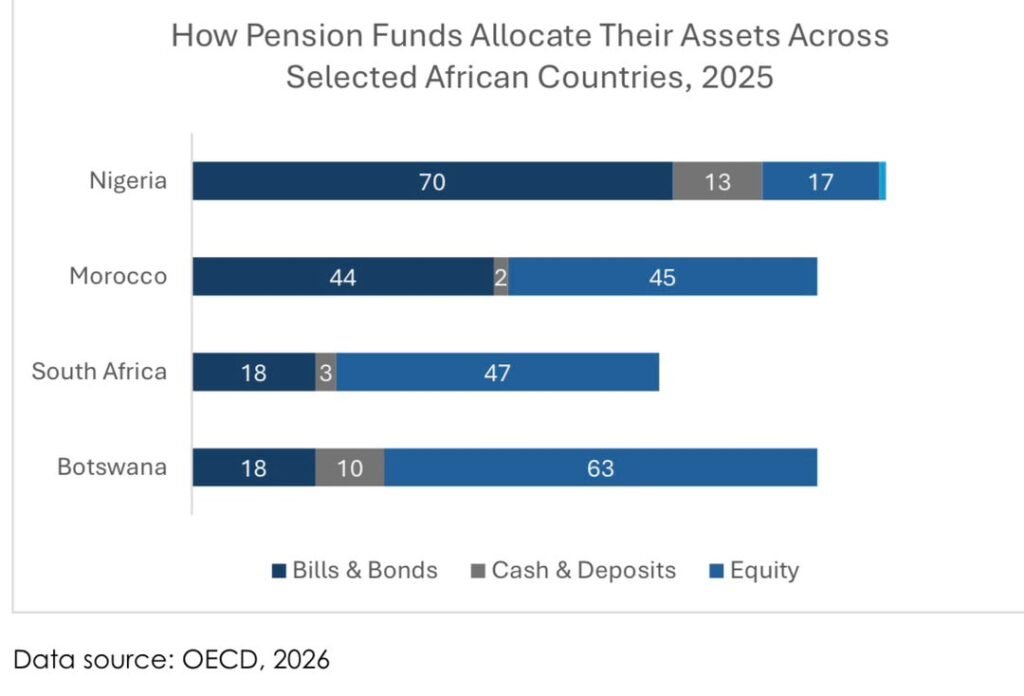
Another constraint lies in how pension funds allocate their existing assets. The OECD reports that African pension funds allocated an average of 44.4% of their portfolios to bills and bonds at the end of 2023, much of it invested in domestic government securities. In Nigeria, about 70% of pension assets are invested in bills and bonds, with most held in government securities. South Africa, by comparison, allocates less than 20% to these instruments, with pension funds investing more broadly in equities, infrastructure and private equity.
Expanding the role of pension funds and insurance companies will require a stronger pipeline of credible investment opportunities. Viable businesses, infrastructure projects and other productive assets, supported by appropriate regulatory frameworks, would give institutional investors more options to diversify their portfolios and channel domestic savings into economic activity.
Unlocking Value in State-Owned Enterprises
State-owned enterprises (SOEs) represent another underutilised opportunity for developing Africa’s capital markets. Operating across strategic sectors such as energy, transport and infrastructure, these companies could attract private investment through public listings and corporate bond issuances. They could also provide the large-scale domestic investment opportunities pension funds need to diversify their portfolios.
According to the OECD, three-quarters of large non-financial SOEs across Africa remain unlisted, limiting their ability to raise equity directly from public markets. Governance weaknesses, poor financial disclosure, political interference and weak accountability further discourage private investment, as investors need confidence in how these companies are managed and how their capital will be deployed.
Bringing well-governed SOEs to capital markets through share listings and bond issuances could expand investment options for pension funds while helping these companies raise long-term funding for growth. Achieving this, however, requires stronger governance, transparent financial reporting, professional management and effective oversight to build investor confidence.
Turning Market Growth Into Real Financing
Africa holds more than USD 4.4 trillion in domestic capital across banks, pension funds, insurance companies, sovereign wealth funds and other financial institutions. Yet businesses across the continent continue to struggle to secure long-term financing, even as stock market valuations rise. The challenge is how to channel more of this wealth into productive investment.
Addressing this will require stronger institutions, stable economic conditions and greater investor confidence. Pension funds need more viable investment opportunities, including well-governed state-owned enterprises capable of raising capital through share listings and bond issuances. Blended finance can also help attract private investors to infrastructure and green projects.
Africa’s capital markets have demonstrated their capacity to grow. The real test is whether they can translate rising valuations and domestic savings into the financing needed by the businesses and infrastructure that will power the continent’s future.