One Year After the AfCFTA Digital Trade Protocol, Is Africa Finally Digitising Its Borders?
From electronic customs documentation to AI-driven logistics, Africa’s push to modernise border procedures is beginning to reshape regional trade, although implementation remains uneven.
Moving goods across African borders has often been slower and more expensive than shipping cargo across oceans. Fragmented customs procedures, manual document verification, inconsistent product standards and congested transit corridors have kept logistics costs exceptionally high in parts of the continent, particularly Central Africa. These barriers continue to constrain intra-African trade.
The AfCFTA Digital Trade Protocol was adopted in February, 2025 aiming to help change this. alongside efforts to develop operational frameworks, signaled a continental commitment to replacing paper-heavy border procedures with interoperable digital systems that could make cross-border trade faster, cheaper and more predictable.
The urgency of this ambition has been reinforced by disruptions to global supply chains. Militant attacks in the Red Sea have forced vessels to reroute around the Cape of Good Hope, adding thousands of nautical miles to some journeys and extending transit times between Asia and Europe. African economies have consequently faced higher freight costs, increased insurance premiums and delays in the delivery of intermediate inputs.
Against this backdrop, digital trade infrastructure offers more than administrative efficiency. It could help African countries strengthen regional supply chains, reduce their exposure to external disruptions and make intra-continental trade more competitive.
The Expectation Versus the Outcome
For context, the busiest land border crossing in East Africa (Mombasa, Kenya to Malaba, Uganda) –average transit time fell from 102 to 68 hours (−33%) from Q1 2025 to Q1 2026 and Mombasa–Busia from 90 to 67 hours (−26%). Both are still above target, by 13 and 10 hours. Mombasa–Taveta (2026 only) averaged 21 hours against a 16-hour target.
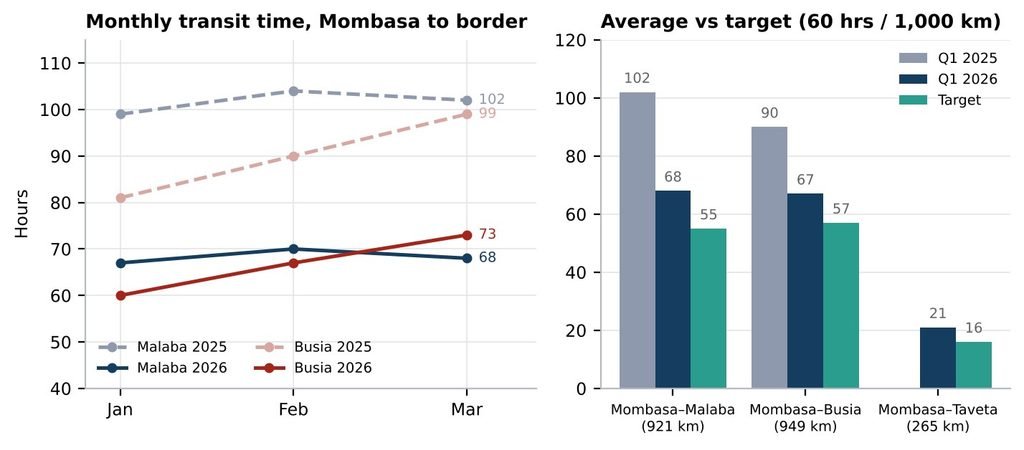
Figure 1. Monthly and average transit time against the 60 hours per 1,000 km target. Source: RECTS data.
In February, 2025, the digital trade annexes were adopted, replacing legacy information technology systems at border posts, the differences in implementation capacity that constantly require human intervention in minimal tasks like collecting a paper printed clearance form from a driver and verifying against 100 other papers, AI adoption saves time by using just bar-codes which takes seconds and immediately trigger boarder access if confirmed or RECTS (Regional Electronic Cargo Tracking System) and AI integration of machine learning, neural networks, and automated analytics into cross-border cargo and customs surveillance (e.g, alerts when cargo goes off-trade routes etc…) can help reduce clogs in trading systems and how AI help fill other gaps in the legal recognition of electronic signatures and cross-border data exchange continue to boost progress.
Bringing in the scorecard points to progress along priority trade corridors, but implementation remains uneven. The expectation was that the Protocol would accelerate the adoption of electronic trade documentation across the continent. What has emerged instead is a more gradual process of corridor-by-corridor modernization, supported by the development of continental digital trade infrastructure.
Although 49 African Union member states have ratified the AfCFTA Agreement and 24 countries have domesticated and gazetted their tariff schedules, full digital customs interoperability remains a work in progress.
Nevertheless, the broader trade environment makes the case for digitization increasingly compelling. In 2025, Africa’s total merchandise trade rose by 6.1 per cent to US213.8 billion.
More significantly, intra-African trade in manufactured goods grew faster than overall trade, according to the 2026 African Trade Report by Afreximbank. This points to emerging regional value chains in sectors such as agro-processing, fertilisers, cement, chemicals and light manufacturing.
These industries depend on reliable delivery schedules and predictable border procedures. Unlike bulk commodities, manufactured goods often require the timely movement of inputs and finished products across multiple markets. Delays at borders can therefore undermine the competitiveness of regional manufacturers, making digital customs clearance an increasingly important component of Africa’s industrial ambitions.
Early Wins Are Taking Shape
At the continental level, AfCFTA institutions have advanced initiatives such as the Continental Electronic Certificate of Origin and the Continental Transit Guarantee System. These are designed to reduce repetitive documentation, simplify customs procedures and limit the need for multiple transit bonds along major trade corridors, including the Abidjan-Lagos, Northern, Central and North-South corridors.
At the national level, countries are also deploying technology to improve customs administration and logistics. Kenya has integrated AI-driven analytics into its customs and revenue systems to strengthen risk assessment and accelerate cargo processing, while South Africa has introduced AI applications into port and logistics operations to improve container tracking and address congestion.
Nigeria, meanwhile, paired the April 2025 gazetting of its tariff concessions with the development of a dedicated air cargo corridor linking it to markets in East and Southern Africa.
Participation in wider trade-facilitation reforms is also expanding. More than 39 countries now trade under the AfCFTA Guided Trade Initiative, which evolved in 2025 from a limited pilot into a platform for testing tariff schedules, rules of origin and digital trade procedures.
Major industrial and agricultural economies, including South Africa, Egypt, Nigeria, Kenya, Côte d’Ivoire, Ghana, Rwanda and Morocco, are among the countries advancing the use of certificates of origin and the alignment of national trade systems with continental standards.
The Industries Benefiting from Digital Trade
Agro-processors, light manufacturers, logistics operators and export aggregators stand to gain most directly from improvements in digital trade facilitation.
In West Africa, Nigeria, the region’s largest intra-African trade exporter, is seeking to move beyond raw cocoa and cashew exports towards processed cocoa products, edible oils and packaged foods for neighbouring markets. This transition is supported by emerging agro-industrial hubs, including Benin’s Glo-Djigbé Industrial Zone.
In Southern and East Africa, South African manufacturers of machinery, vehicles, chemicals and processed foods are looking to expand their regional markets. Similarly, Kenyan special economic zones, including those at Dongo Kundu, Naivasha and Vipingo, are positioned to benefit from more efficient customs procedures and electronic documentation that can improve access to regional consumers.
Even in Central Africa, where the Democratic Republic of Congo increased its share of intra-African trade from 4.74 per cent to 6.74 per cent in 2025, investments along the Lobito Corridor are combining rail infrastructure upgrades with efforts to modernise trade facilitation.
The wider economic implications extend beyond faster cargo clearance. Lower border delays and compliance costs can make regional sourcing more attractive, strengthen supply-chain resilience and expand the market available to African producers.
This is particularly important as global trade tensions and disruptions to traditional shipping routes expose the vulnerabilities of relying heavily on distant markets. The 2025 US reciprocal tariffs, which affected a broad range of African economies, further underscored the need to diversify export destinations. More efficient regional corridors could help African businesses source inputs and sell finished products closer to home.
The Road Ahead Requires Decisive Execution
Despite the progress, significant gaps remain. Roughly half of African states have yet to finalise and gazette their full tariff schedules, while negotiations over rules of origin remain sensitive in sectors such as textiles and automotive manufacturing.
Cross-border data-sharing arrangements also need to be incorporated into domestic legal frameworks. An electronic manifest issued at one port, for instance, must be recognised by customs authorities at an inland border hundreds of miles away if digital trade systems are to deliver their full benefits.
Governments must therefore move beyond policy commitments and prioritise implementation. This will require investment in broadband connectivity at border posts, mutual recognition of electronic certificates of origin, stronger cross-border data-sharing arrangements and the expansion of African Quality Assurance Centres to support digital standards compliance.
The AfCFTA Digital Trade Protocol has established an important framework for modernising Africa’s trade infrastructure. But its success will ultimately be measured not by the number of countries that adopt digital systems or sign agreements, but by how much faster and cheaper businesses can move goods across African borders.
Digitising the border is no longer a technical luxury. It is becoming a foundation for Africa’s industrial competitiveness and the realisation of the continent’s single-market ambitions.