
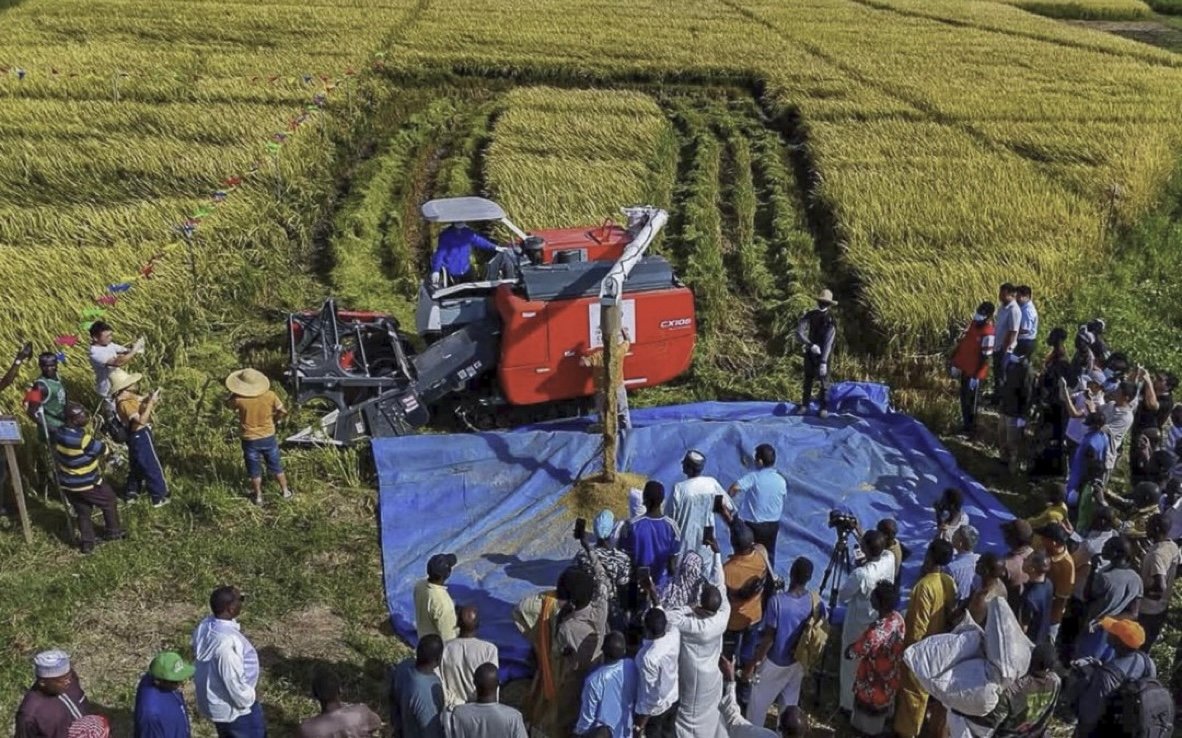
In the rice fields of Douguia and Bongor, a red combine harvester moves through golden stands while local farmers and officials watch from the edge of the paddy. The scene has come to define China’s 8th Agricultural Technical Assistance Project in Chad.
In November 2026, the initiative was named a Recommended Case in the 7th Global Solicitation on Best Poverty Reduction Practices, announced at a poverty-reduction seminar in Beijing.
The selection places the Chad project among 126 cases chosen from 890 submissions across 31 countries. Backed by the World Bank, the Food and Agriculture Organization, the World Food Programme, and Chinese development bodies, the solicitation sought practical, replicable models that build lasting local skills rather than relying on short-term aid.
Chinese officials describe the effort along those lines, focusing on better seeds, cultivation methods, water management, and market access developed alongside Chadian counterparts.
Running from March 2024 through 2027, the current phase extends a bilateral program that began in 2006.
Over two decades, eight Chinese teams totaling more than 100 specialists in agronomy, machinery, and irrigation have worked in the country.
Fourteen Chinese experts are currently stationed at demonstration sites in Douguia (Hadjer-Lamis Region) and Bongor (Mayo-Kebbi Est), partnering directly with Chad’s Institute of Agricultural Research for Development (ITRAD).
Project records point to several measurable gains. In July 2026, three Chinese-bred rice varieties were formally added to Chad’s national seed catalog.
Teams have also dug roughly five kilometres of new irrigation canals and trained over 2,000 farmers in the current cycle, bringing cumulative training since 2006 to between 3,000 and 5,000 people.
According to project leaders, these improved varieties now cover more than 600,000 hectares, yielding about 35% more than local strains and generating an estimated 1.2 million extra tonnes of rice, enough to feed three million people for a year. One demonstration plot averaged nine tonnes per hectare.
Chadian officials and growers describe the impact in everyday terms. Watching a recent harvest, Mahamat Ahmad Alhabo, Secretary General at the Presidency, said the methods prove Chad can grow enough rice to feed itself and eventually export the surplus.
Baradine Kadre, a longtime demonstration-site farmer, said seeing a mechanical harvester work the fields filled him with pride. Another farmer, 35-year-old Oumar Souleymane, noted that hands-on training in seed production and plowing, paired with fertilizer provided during land preparation, has helped local growers feed their households.
Chadian Minister of Production and Agricultural Industrialization Keda Ballah has credited the mission with advancing technology transfer and assigned donated machinery to pilot cooperatives.
However, even with the 2024 rebound, the landlocked west African country still faces a large milled-rice deficit relative to estimated consumption. National plans (“Tchad Connexion 2030”) target 1.62 million tonnes of paddy by 2030—an ambitious jump that would require sustained yield gains, irrigation expansion, and seed systems beyond current demonstration-site results.