
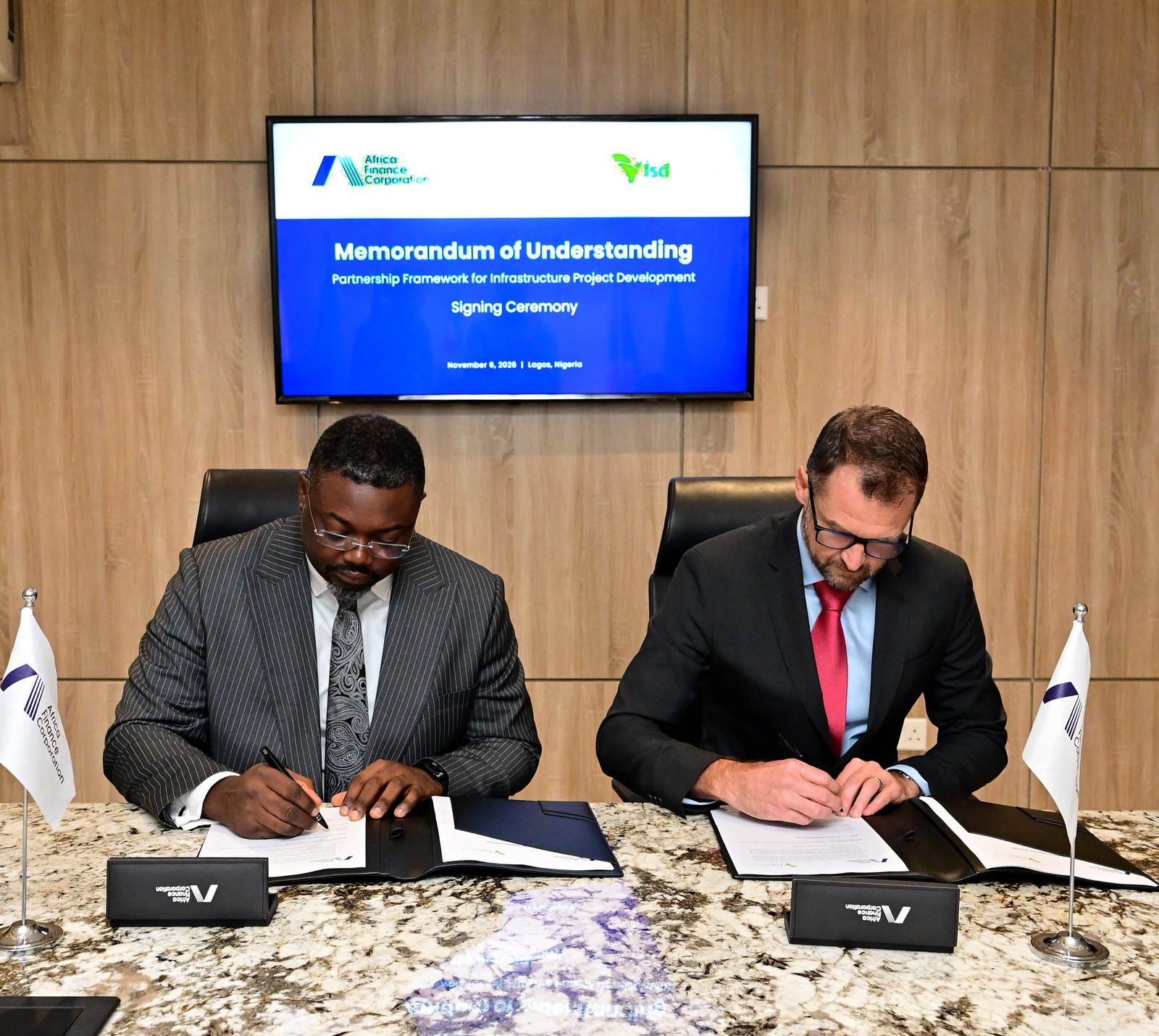
Africa Finance Corporation (AFC) and FSD Africa have signed a memorandum of understanding to unlock early-stage capital and accelerate critical infrastructure projects in Ghana, Nigeria and Kenya.
According to a post on the X platform by AFC on Monday, the partners will combine project development capital with catalytic grant funding to drive bankable projects. The signing ceremony took place in Lagos on November 8.
The partnership targets the persistent shortage of investment-ready projects that prevents available capital from reaching African infrastructure. It focuses on combining AFC’s development expertise with FSD Africa’s catalytic funding tools.
Africa faces an annual infrastructure financing gap estimated at $130–170 billion, according to the African Development Bank. Nigeria alone requires roughly $100 billion annually, while Ghana’s National Infrastructure Plan needs about $37 billion yearly.
AFC’s 2025 Development Impact Report shows its backed projects contributed over $51 billion to GDP and supported 3.9 million jobs. They connected 5.8 million households to power and improved transport access for 173.7 million people.
In its FY2025 results, AFC reported total assets of $19.23 billion, up 33.5 percent, and total comprehensive income of $513.8 million. Earlier in 2026, it raised a record $2 billion syndicated loan.
FSD Africa, primarily funded by the UK’s FCDO, mobilised and catalysed $1.7 billion in private capital between 2021 and 2025. More than one-third of this was local capital, supporting over 22,000 jobs.
The new MoU follows AFC’s recent progress on the Lobito Corridor railway, including meetings with the presidents of Angola and Zambia. It also comes after AFC’s launch of a $690 million Africa Sovereign Climate Facility with the Green Climate Fund.
By focusing on early-stage project preparation in three key markets, the partnership aims to convert more concepts into financeable deals. This addresses a core bottleneck in a continent where institutional capital exceeds $2 trillion yet infrastructure remains underfunded.