

The panic that gripped Nigeria’s foreign exchange markets just a few years ago seems to be firmly in the rearview mirror.
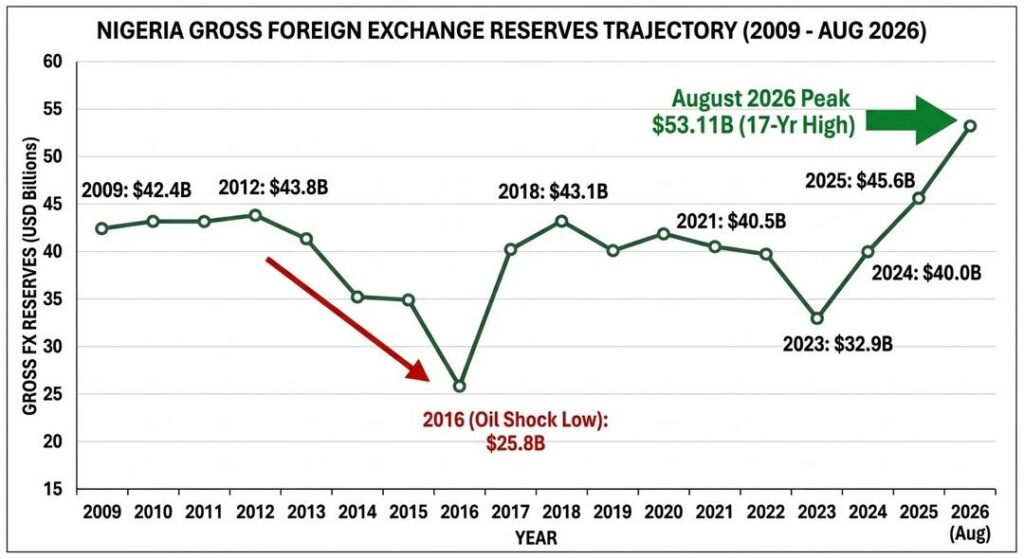
Data from the Central Bank of Nigeria (CBN) confirms that the nation’s gross foreign exchange reserves crossed the $53.11 billion mark in late August 2026. This is not just a nominal victory; it is the highest reserve buffer Africa’s most populous nation has recorded since January 2009.
More importantly, it signals that the orthodox monetary policy framework championed by CBN Governor Olayemi Cardoso is yielding tangible macroeconomic dividends.
To understand the magnitude of this recovery, one must look at the trajectory. Opening the year at $45.56 billion, the reserves have seen a year-to-date accretion of over $7.5 billion, a 16.5% expansion that has pushed the apex bank past its initial 2026 baseline projection of $51.04 billion a full four months early.
Today, the liquid component of this buffer provides upwards of 11 months of import cover, dwarfing the international benchmark of three months and significantly de-risking Nigeria’s external debt servicing capacity.
But the real story for financial markets is not just the total sum; it is the strategic pivot in how these dollars were accumulated.
Halting the Naira Artificial Defense
For years, the CBN bled foreign reserves in a costly, attempt to artificially peg the naira. Cardoso’s most critical reform was stepping back from the market.
By allowing the currency to find its market-clearing rate, the CBN effectively ended the era of subsidizing foreign exchange for arbitrageurs. Official interventions now account for a fraction of total FX turnover—hovering near a mere 1.2% in 2025—which immediately plugged the structural leak that had previously drained the nation’s buffers.
The result? The naira has found relative stability around the N1,338 – N1,349/$1 band, with the spread between the official window and the parallel market virtually collapsing.
The Remittance Pivot
Rather than relying solely on crude oil receipts which remain vulnerable to global price shocks and localized production shut-ins, the CBN engineered a deliberate diversification of dollar inflows.
By cleaning up the regulatory framework for International Money Transfer Operators (IMTOs) and ensuring market-reflective pricing, the apex bank successfully redirected diaspora flows from shadow channels back into the official system. The CBN is currently capturing roughly $600 million monthly in remittance inflows, aggressively tracking toward a $1 billion monthly target.
Orthodox Tightening and Yield-Hungry Capital
By holding the Monetary Policy Rate (MPR) at elevated levels—currently at 26.5%—the CBN has systematically mopped up excess naira liquidity while making local fixed-income assets incredibly attractive.
This orthodox tightening has reversed years of capital flight. Yield-hungry Foreign Portfolio Investment (FPI) has flooded back into government securities and short-term debt instruments, injecting fresh foreign exchange liquidity directly into the interbank market.
By holding spot yields on 364-day Open Market Operations (OMO) bills and Treasury Bills between 19.8% and 22%+, the apex bank created a compelling carry-trade environment for offshore investors.
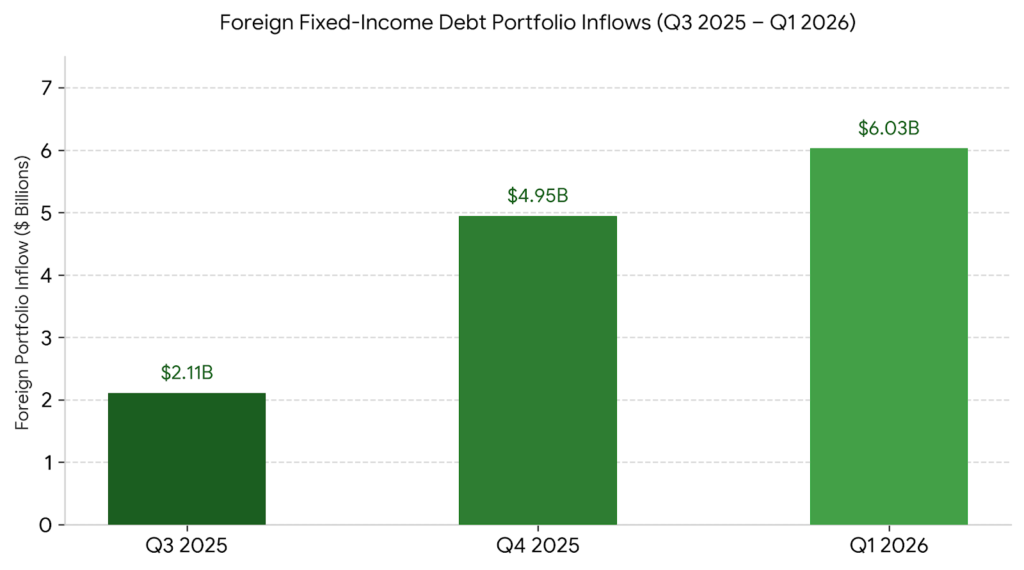
The market response was immediate: Foreign Portfolio Investment into local debt securities surged to $4.95 billion in Q4 2025, more than doubling the $2.11 billion recorded in the previous quarter, before total portfolio inflows expanded by another $6.03 billion in Q1 2026.
This foreign appetite has consistently played out in primary market sales, where offshore accounts frequently commanded up to 79% of foreign allocations in single auctions.
A prime example occurred in August 2026, when a N1.0 trillion OMO offering triggered a staggering N4.4 trillion in aggregate bids. This 400% oversubscription allowed the CBN to mop up N1.9 trillion in excess system liquidity while funneling organic, market-driven dollar inflows directly into interbank trading channels.
The Recapitalization Catalyst
Adding to this accretion was the successful conclusion of the 24-month banking recapitalization exercise on March 31, 2026.
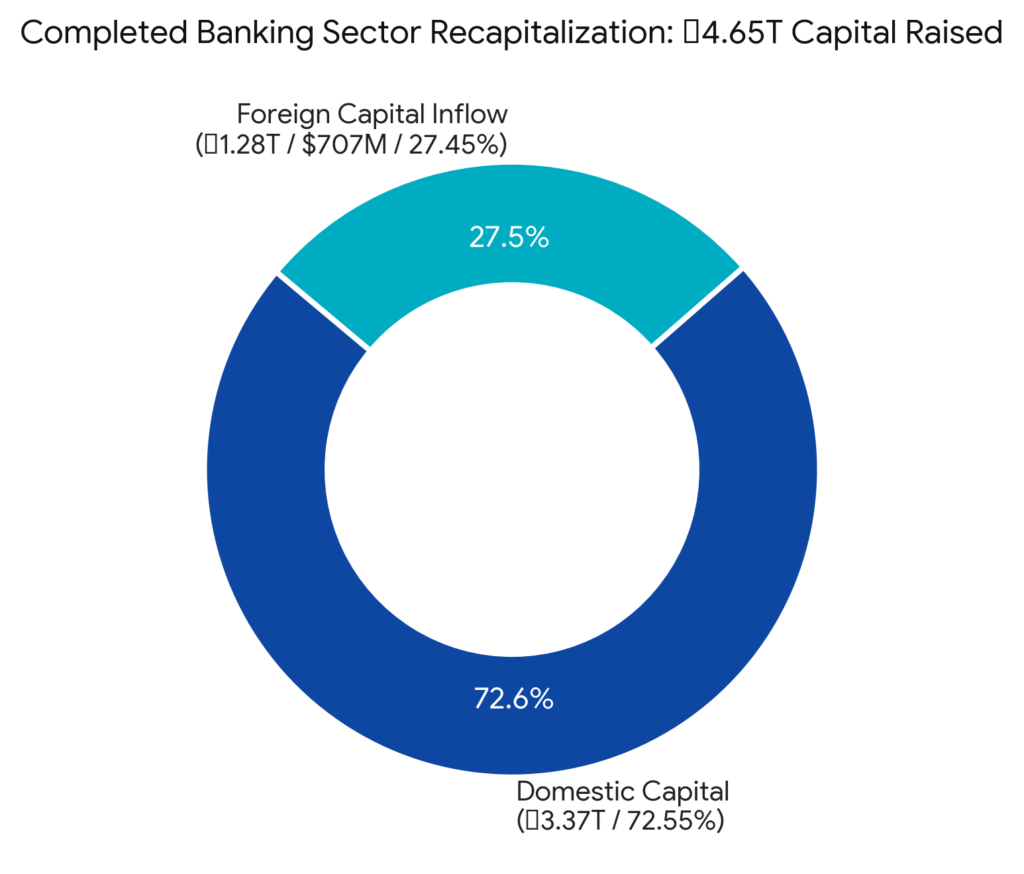
The policy yielded N4.65 trillion in total fresh capital across 33 fully compliant lenders.
Crucially for the CBN’s foreign exchange balance sheet, 27.5% of those funds—roughly $707 million—came via direct foreign equity and portfolio investment. This delivered a non-debt, organic influx of dollar liquidity straight into the financial system.
Combined with the concurrent expansion of domestic refining capacity, which dramatically stripped away the structural demand for petroleum-import dollars, the apex bank was able to retain its reserve gains rather than fighting structural leaks.
Looking Ahead
“When we were building the reserves, there was a lot of cynicism,” Cardoso recently noted, reflecting on the days when external obligations mounted and market confidence evaporated. “We said we needed to diversify our reserves, and we went into remittance inflows.”
The $53 billion milestone proves that orthodox macroeconomics, driven by transparent data and disciplined monetary policy, works. However, the ultimate test for the CBN will be sustainability.
Maintaining this 17-year high will require holding the line on liquidity tightening, resisting the political temptation to revert to aggressive market interventions, and continuing to deepen the transparency of the official FX window.
For now, the data is unequivocal: Nigeria’s macroeconomic buffers are back.