By: ThinkBusiness Africa
Economic activity in Nigeria reached its strongest level of the year in December, driven by a broad-based expansion across the industrial, agricultural, and service sectors. According to the latest Purchasing Managers’ Index (PMI) report released by the Central Bank of Nigeria (CBN), the composite PMI rose to 57.6 points, up from 56.4 in November.
This latest data marks the 13th consecutive month of expansion for the Nigerian economy, signaling a robust and sustainable growth momentum as the year draws to a close.
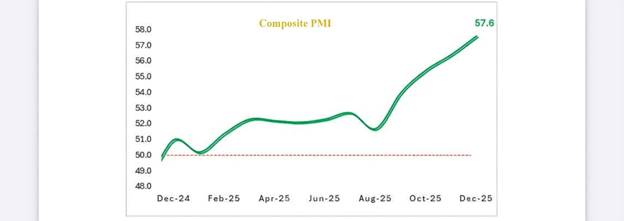
Source: CBN
Broad-based growth across key sectors
According to the PMI report, the expansion was nearly universal, with 32 out of the 36 subsectors surveyed reporting growth. The report highlights that the overall contractionary impact from the few struggling subsectors was “insignificant” compared to the widespread gains.
- The agriculture sector led the charge recording 58.5 points, the sector recorded its 17th straight month of expansion. All five subsectors within this category saw growth, primarily fueled by general farming activities.
- With 57.0 points, the industrial sector reached its highest expansionary trajectory since March 2020. Of the 17 industry subsectors, 14 reported growth, with Transportation Equipment posting the strongest performance. Conversely, Paper Products experienced the most significant decline.
- Sustaining growth for the 11th consecutive month, the service sector saw 13 of its 14 subsectors expand, while one remained stationary. The sector recorded 56.4 points
The report noted significant improvements in several critical operational areas:
- The Output index stood at 60.0, and New Orders reached 58.7, underscoring high demand and production levels.
- The employment level index rose to 54.2, indicating increased labor engagement across the economy.
- The Suppliers’ Delivery Time index improved to 58.2, reflecting faster response times and better efficiency in supply chains.
Price pressures persist
Despite the positive growth, the report indicated that inflationary pressures remain a factor. Input price indices for all major subsectors remained higher than their corresponding output price indices, suggesting that businesses are continuing to face rising costs.
Externally, analysts have noted that while the festive season has traditionally driven a “profit bulge” in retail and hospitality—with intercity travel fares rising by 30-40% this month—persistent structural challenges remain. Farmers have reported that the cost of production for major crops rose between 29% and 36% in 2025 due to high fertilizer and fuel costs.
The CBN’s noted that the December performance reflects a “notable strengthening” of industrial performance. This aligns with broader macroeconomic forecasts for the coming year.
On Tuesday, the CBN projected a stronger outlook for 2026, forecasting: a 4.49% GDP growth, up from an estimated 3.89% in 2025; Inflation is expected to moderate to an average of 12.94% in 2026 from 21.26% in 2025; and external reserves rising to $51.04 billion, from $45 billion in 2025.
These projections suggest that the year-end PMI surge is not merely a seasonal peak but part of a transition toward a more resilient, growth-oriented phase for the Nigerian economy.