
Sub-Saharan Africa stands at a critical juncture in its development trajectory. As of recent institutional tracking, approximately 565 million to 600 million Africans lack access to reliable electricity, representing over four-fifths of the global unelectrified population (World Bank & AfDB, 2024).
In response to this structural deficit, the World Bank Group and the African Development Bank (AfDB) jointly launched ‘Mission 300’ (M300), a transformative, continent-wide initiative aiming to expand electricity access to 300 million people across Sub-Saharan Africa by 2030 (World Bank, 2024).
Under this division of institutional responsibility, the World Bank Group has committed to connecting 250 million individuals, while the AfDB targets 50 million connections (AfDB & WBG Joint Operational Framework, 2024). Beyond social development, M300 operates as a core macroeconomic engine.
By bridging the power deficit, the initiative seeks to unlock industrial productivity, accelerate digital connectivity, enhance agricultural value chains, and generate structural employment across a region where 12 million young job-seekers enter the labor market annually (World Bank, 2025).
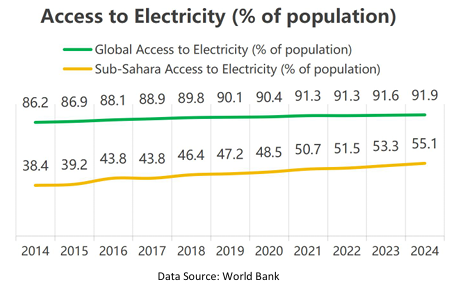
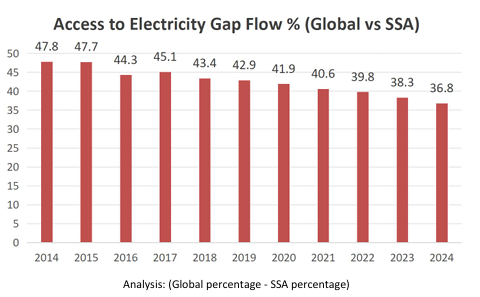
55.1), while global average increased by 6.6% from 2014 to 2024 respectively.
M300 Implementation Progress & Operational Milestones: What is the update?
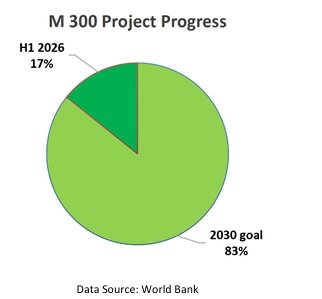
Operational execution under M300 has accelerated. By mid-2026, official reporting confirmed that the initiative had successfully connected over 50 million people to electricity across 40 African nations (World Bank Press Release, June 2026).
M300 achieved 17% progress in 2years. (From the initial 6 years plan). At this pace it would reach 51% of it initial target (126 million people by 2030).
This milestone demonstrates early structural traction, driven by early-phase grid expansions and off-grid deployments in primary focus countries including Tanzania, the Democratic Republic of Congo (DRC), Ethiopia, Madagascar, and Zambia (World Bank Progress Portal, 2026).
A central mechanism driving this operational momentum is the establishment of National Energy Compacts.
Endorsed by 48 African nations and the African Union, with 30 countries actively implementing tailored compacts, these roadmaps align policy reforms with concrete investment pipelines (Rockefeller Foundation / M300 Tracker,
2025).
During the inaugural M300 Africa Energy Summit, 12 pioneer nations including Nigeria, DRC, Tanzania, Côte d’Ivoire, Senegal, and Zambia, presented compacts designed to roughly double their aggregate installed generation capacity from 56 GW to 108 GW (Africa Energy Portal, 2025).
This expansion is projected to increase average available power capacity from 38 watts to 63 watts per capita, providing the necessary baseline for industrial value addition.
Financial Architecture & Capital Mobilization
Closing Africa’s energy access gap requires unprecedented scale in capital deployment. Total public and private investment required to fulfill M300 objectives is estimated at upwards of USD 238 billion (AfDB / Energy Sector Analysis, 2025).
To anchor this mobilization, the World Bank Group committed USD 30 billion in direct financing between 2024 and 2030 effectively doubling its historical energy-sector lending to Africa (World Bank Mobilization Framework, 2024).
Concurrently, global development partners and philanthropic entities, including the Rockefeller Foundation and the Global Energy Alliance for People and Planet (GEAPP), have pledged over USD 6 billion in initial co-financing.
Crucially, public finance alone cannot bridge the funding gap. The M300 financial model leverages multilateral de-risking mechanisms to crowd in private institutional capital.
Through the International Finance Corporation (IFC) and the Multilateral Investment Guarantee Agency (MIGA), the initiative utilizes political risk guarantees, local currency hedging, and competitive procurement frameworks to convert early-stage utility projects into bankable commercial assets (IFC Strategic Brief, 2025).
Key Insights & Macroeconomic Implications
First, M300 enforces a dual-track technological model. Capital distribution is balanced between national grid extensions—accounting for approximately 50% of target connections—and distributed renewable energy (DRE) systems, such as solar mini-grids and standalone home systems (World Bank Energy Progress Analysis, 2025).
This blended model allows rapid deployment to remote populations without waiting for costly, long-distance transmission infrastructure.
Second, power reliability directly correlates with labor productivity and industrial output.
Africa’s current average electricity consumption hovers at a modest 40 watts per capita, with modern renewables representing only 12% of total primary energy use (Africa Energy Portal, 2025).
By stabilizing grid reliability and bringing localized renewable power to micro, small, and medium-sized enterprises (MSMEs), M300 is projected to catalyze millions of productive jobs in light manufacturing, agro-processing, and digital services by 2050.
Third, institutional utility reform remains the primary bottleneck to long-term sustainability.
Electricity connection targets cannot be sustained if state utilities remain financially insolvent. Consequently, M300 funding is strictly conditional on cost reflective tariffs, reduction of technical and commercial loss rates, and enhanced governance structures within national power companies.
Strategic Outlook & Risk Governance
While reaching 50 million connections marks a major milestone, scaling to 300 million by 2030 requires maintaining an exponential execution pace.
Key structural risks include macroeconomic volatility, local currency depreciation against foreign debt obligations, political transitions, and supply chain bottlenecks for renewable hardware.
Sovereign risk mitigation and sustained political leadership through National Energy Compacts will be decisive in ensuring that M300 delivers on its promise of universal, productive energy access across Africa.
KEY INSIGHTS & CORE ANALYTICAL TAKEAWAY
Mission 300 shifts the paradigm from fragmented, project-based rural electrification to a systemic capital mobilization model. By binding financial commitments to policy reforms, M300 reduces sovereign risk and lays the structural foundation for self-sustaining private power markets.
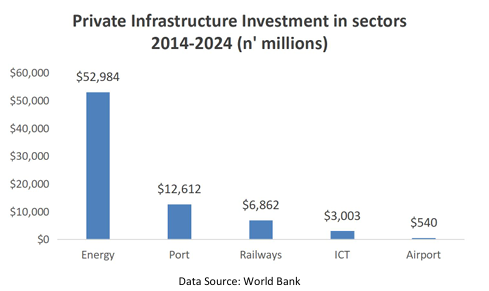
M300 achieved 14% progress in 2years. (From the initial 6 years plan). At this pace it would reach 42% of it initial target (126 million people by 2030). More PPI investment is needed in to scale project execution rate.