South Africa Opens State-Led Rail and Port Corridors to Private Sectors
The Reconfiguration of Infrastructure Capital
South Africa has opened it state-led rail and port corridors to private sector integration. This allows private miners and exporters to invest directly in upgrading freight rail networks and ports.
For decades, the standard playbook for African infrastructure development relied heavily on balance-sheet financing from sovereign governments and bilateral loans from foreign development partners.
According to African Development Bank (AfDB) estimates, Africa faces an annual infrastructure financing gap of $68 billion to $108 billion out of a total requirement of $130 billion to $170 billion annually.
In response to these sovereign constraints, a new private sector playbook is rapidly emerging.
Rather than relying on high-risk, unhedged public-private partnerships (PPPs) or waiting for comprehensive state guarantees, private investors are pioneering localized, commercially resilient investment models.
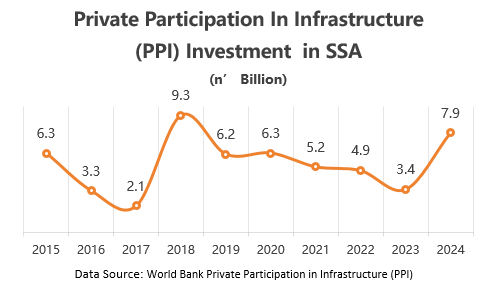
2015 to 2017 shows a 47.5% decline in investment volume, ($8 billion to $4.2 billion). 2015 was an unusually strong year for SSA PPI, with investment increasing 252% from $2.5bn in 2014 to $6.3bn.
. However, the increase was highly concentrated: 22 of the 23 projects were in energy, accounting for about 96% of investment. Investment subsequently fell 48%, from $6.3bn to $3.3bn.
The World Bank recorded only 11 SSA infrastructure deals, compared with 23 in 2015. Nine were energy projects and two were transport. 2017, this was the weakest point of the decade up to that point.
SSA attracted only $2.1bn across 19 projects, the second-lowest level in the previous ten years. Ghana and Rwanda were the largest recipients, with $550m and $422m respectively.
In 2018, there was also a structural change in the type of infrastructure attracting capital.
Globally, transport became the largest PPI sector in 2018, while renewable energy continued to dominate electricity-generation investment. 2018 represented a return of larger infrastructure transactions, supported by renewable energy, transport and improving PPP frameworks.
2019, investment decline by 33% from 2018 levels (9.3 to 6.2 billion). The major change was South Africa’s weakness.
South Africa’s PPI investment dropped to just $972m, its first time below $1bn since 2014. The World Bank linked this partly to the financial and operational crisis at Eskom.
Eskom’s debt burden and concerns over possible renegotiation of renewable-energy power-purchase agreements increased investor uncertainty. 2019 was not a collapse in African PPI. It was a re-balancing away from South Africa, as Ghana, Nigeria and several other countries attracted investment. Ghana attracted $1.5bn, while Nigeria attracted $1.1bn, including the Lekki Deep Sea Port project.
From 2020-2023,investment declined by 46% (6.3 to 3.4 billion). COVID-19 did not eliminate African infrastructure investment. Instead, SSA proved relatively resilient because infrastructure projects already sufficiently advanced to financial close continued to move forward while other regions experienced larger disruptions.
2021 was a broadening but smaller market: total investment declined, but more countries participated. 19 SSA countries recorded PPI transactions, compared with 16 in 2020 and an average of 14 over the previous five years. Botswana, Ethiopia and Eswatini returned to the PPI market after long periods without transactions.
2022 marked a shift from large concentrated transactions toward broader but smaller PPI activity. SSA recorded its highest number of PPI projects and participating countries in a decade.
The World Bank explains that SSA had benefited from investment flows during the pandemic because other major PPI destinations such as East Asia and Latin America were experiencing greater disruption. 2023 was not necessarily a collapse in private infrastructure activity. Rather, it was a collapse in the average size/value of transactions reaching financial close.
2024, SSA PPI investment reached $7.918bn across 47 projects, up 232% from $3.4bn in 2023. Investment increased, while the number of projects fell from 66 to 47.
That means the rebound was driven by larger transactions, rather than a broad increase in the number of projects. The geographical composition also changed. Angola accounted for 30% of SSA’s PPI investment, followed by South Africa and Senegal. Energy remained the largest sector, followed by transport
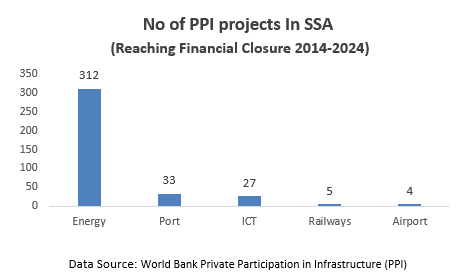
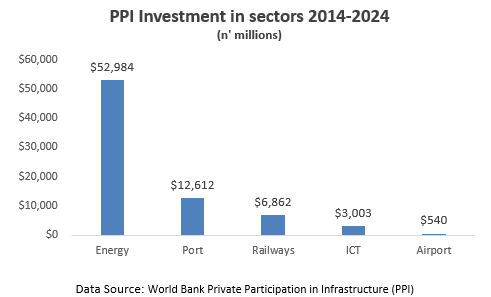
Institutional sponsors, private equity firms, and global infrastructure funds are re-calibrating their allocation strategies toward asset classes that offer rapid payback periods, robust foreign currency hedging mechanisms, and high operational cash-flow predictability like energy (electricity), ICT (data center, 5g cable fibres etc) and transport systems.
Key Vectors of the New Private Sector Playbook
The updated strategic playbook centers on three structural pillars: digital infrastructure expansion, decentralized utility solutions, and trade corridor logistics under the African Continental Free Trade Area (AfCFTA) framework.
A. Digital Connectivity as a High-Yield Utility
Information and communication technology (ICT) infrastructures like Data centers, fiber-optic networks, and telecom towers have transcended traditional tech categories to become prime real asset targets.
Global tech conglomerates and institutional investors allocated over $3 billion into pan-African data center and ICT infrastructure over the years, according to regional market analyses. Data centers located in key hubs such as Lagos, Nairobi, and Johannesburg report projected compound annual growth rates (CAGR) exceeding 15%.
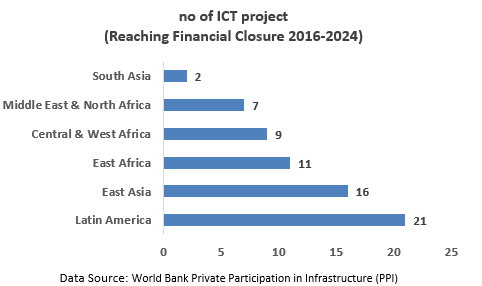
Despite the growth of ICT development in Africa, the intensity of PPI investment across zones are not equal as shown by the chart above while comparing with other region across the globe.
ICT industry in Africa is a major source of attraction for global investors. Private capital favors digital assets because their revenues are anchored by multi-nationals and enterprise clients under long-term, hard-currency-denominated contracts, neutralizing local FX volatility risks.
B. Decentralized and Captive Power Models
Large-scale national grid projects often suffer from lengthy procurement delays and regulatory bottlenecks. Consequently, private capital is pivoting sharply toward commercial and industrial (C&I) solar, captive power plants for mines and industrial zones, and mini-grids.
According to the Infrastructure Consortium for Africa (ICA), while total commitment allocations to energy infrastructure stood at $28.3 billion in recent reporting cycles, direct private investments in decentralized energy solutions increased by 34% year-over-year.
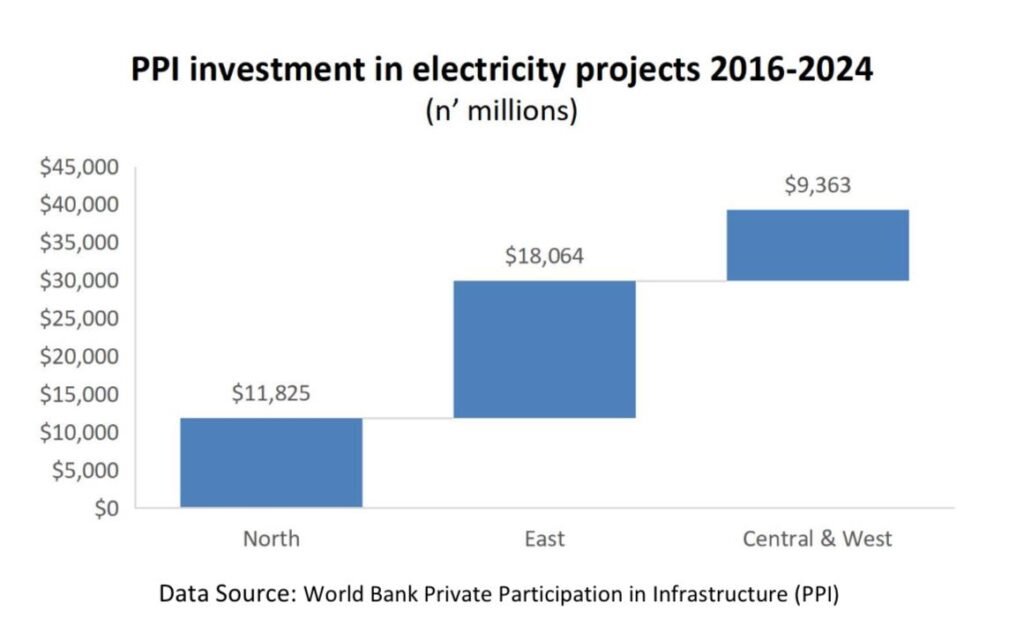
Despite the growth of mini grids in Africa, there is an uneven distribution across zone with North Africa having thee lowest PPI investment.
This shouldn’t be surprising a North africa has the highest level of access to electricity compared to other regions (showcasing a stable generation and distribution infrastructure).
Independent Power Producers (IPPs) selling directly to creditworthy commercial off-takers bypass financially distressed state utilities, securing reliable yields.
C. Logistics Corridors and Port Optimizations
The implementation of AfCFTA, representing a unified market of 1.3 billion people and a combined GDP of $3.4 trillion, has catalyzed private investments in cross-border trade corridors. Private operators are deploying capital into specialized logistics hubs, inland container depots, and port modernizations.
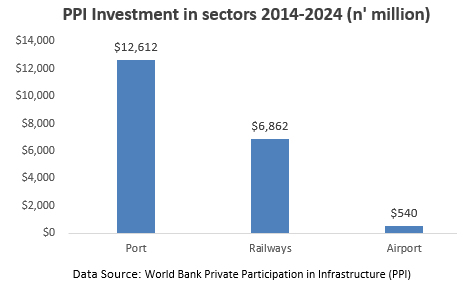
With the establishment of African Continental Free Trade Area (AfCFTA), investment in logistics infrastructure connecting different region has now become a most. The most invested logistics system in Africa are the Port and railways (freight logistics) they are key to scaling commercial and industrial operations in Africa.
For instance, private port concessionaires have committed upwards of $4 billion in modernizing West and East African maritime gateways over recent cycles, achieving operational turnarounds that drastically reduce ship turnaround times and yield double-digit EBITDA margins.
De-Risking via Advanced Financial Engineering
The success of the new private sector play depends less on asset selection and more on risk mitigation structuring.
Historically, currency depreciation and political uncertainty acted as severe deterrents to international capital. Today, project developers employ sophisticated blended finance structures to de-risk investments.
Data from the Convergence Blended Finance platform demonstrates that Sub-Saharan Africa remains the single largest destination for blended finance deals globally, accounting for nearly 43% of total historical transaction volume.
Development Finance Institutions (DFIs) such as the International Finance Corporation (IFC) and the U.S. International Development Finance Corporation (DFC) provide first-loss equity, political risk insurance (PRI), and partial credit guarantees (PCGs).
This concessional capital layer effectively absorbs early-stage execution risks, allowing commercial banks, domestic pension funds, and institutional asset managers to enter at acceptable risk-return thresholds.
Furthermore, local currency financing is gaining significant traction. Institutional investors are co-investing with domestic pension funds such as those in Nigeria and Kenya, which manage combined assets under management (AUM) exceeding $40 billion to issue local-currency-denominated infrastructure bonds, shielding projects from foreign exchange mismatch.
Strategic Implications for Policy and Capital Allocation
The evolution of private sector participation signals a fundamental shift in the broader economic landscape of African development:
Disintermediation of the State: The state is increasingly viewed not as the primary provider of infrastructure, but as a regulatory enabler. Projects that minimize reliance on public subsidies or state off-take guarantees demonstrate significantly shorter closure times.
Asset Monetization and Secondary Markets: Private investors are creating secondary exit routes through infrastructure real estate investment trusts (REITs) and yield listed on local and international exchanges, unlocking secondary liquidity.
ESG and Climate Alignment: Infrastructure projects adhering to strict environmental, social, and governance (ESG) guidelines unlock access to green bonds and climate finance facilities, which reached over $100 billion in global issuance commitments targeting emerging markets.
Conclusion
The private sector’s new play in African infrastructure is defined by pragmatic asset selection, risk-hedged financial structures, and alignment with structural megatrends such as digitization, urbanization, and intra-African trade.
By shifting away from capital-intensive state megaprojects toward modular, commercially viable, and blended-finance-backed assets, private capital is proving that infrastructure in Africa can be both highly profitable and transformative for regional economic development.
KEY INSIGHTS
Private capital in African infrastructure is shifting from traditional state-backed PPPs to commercial blended finance, digital backbone expansion, and decentralized off-grid energy.
Development Finance Institutions (DFIs) provided 43% of total infrastructure financing commitments in recent years, but investment commitments in infrastructure projects with private participation are closing the $100 billion annual deficit through risk-mitigated structures.
Telecommunications and logistics corridors yield the highest risk-adjusted commercial returns, outstripping conventional mega-utilities.