Intra-African trade reached $213.8 billion in 2025, up 5.5%, but the continent continues to do the overwhelming majority of its business with outsiders.
The numbers come from an Africa Business Convention brief, built on Afreximbank data, and are reinforced by the bank’s African Trade Report 2026, which also puts total merchandise trade near $1.5 trillion.
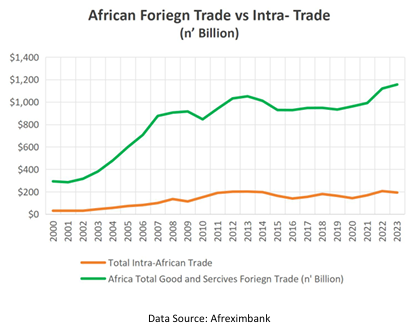
From 2000 to 2024 the continent recorded $3.37 trillion in cumulative internal trade. Annual flows rose from $31 billion to roughly $200 billion, yet the internal share has stayed stuck between 12% and 16%.
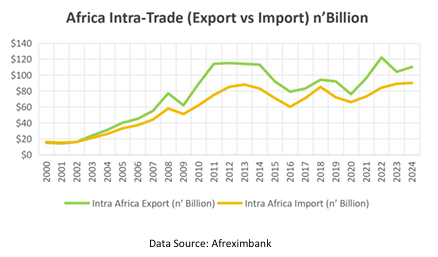
Intra-African trade remains more volatile than external trade, swinging harder on tariffs, logistics and payments. That elasticity has not translated into a structural shift.
Exports within Africa have consistently exceeded imports, producing a seller-heavy market. The gap is narrowing, but slowly. Post-2020 import growth outpaced export growth, a quiet signal that buyers are finally gaining weight.
South Africa still accounts for nearly one-fifth of all intra-African trade. Nigeria’s recent jump to $9.02 billion is largely refined fuel from the Dangote Refinery moving to neighbours that previously bought from Europe and Asia.
Africa is now its own third-largest trading partner after Asia and the European Union. The ranking looks better on paper than the composition does: mineral fuels and metals remain dominant even as manufactured goods take a larger slice.
The Pan-African Payment and Settlement System is expanding quickly and cutting transaction costs, while more than two dozen countries have gazetted AfCFTA tariff schedules. Preferential access is no longer theoretical.
A trade-finance gap estimated at $74–100 billion continues to block smaller firms. Only a fraction of African banks’ trade-finance books supports internal trade. Without capital, tariff cuts stay on paper.
Data revisions have also been large. One year’s reported growth has at times been smaller than the subsequent restatement of the prior year, underlining how fragile the published series still are.
The brief’s long-run picture and the latest Afreximbank numbers point to the same constraint: volume is rising, but the structural ceiling has barely moved. Closing the finance, logistics and processing gaps remains the difference between incremental growth and a genuine continental market.