
By: ThinkBusiness Africa
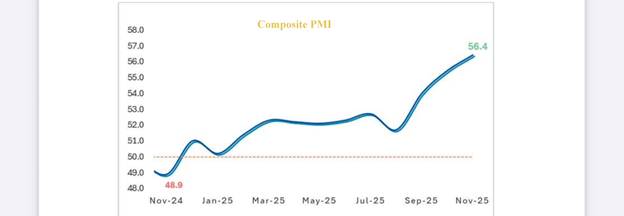
Nigeria’s economic activities surged to its strongest level of 2025 in November, with the Composite Purchasing Managers’ Index (PMI) hitting 56.4 points; signaling the twelfth consecutive month of expansion, providing strong evidence that the west African nation’s recent monetary and fiscal reforms are yielding tangible results.
The November PMI, which rose from 55.4 points in October, is seen by analysts as validation of the central bank of Nigeria’s (CBN) commitment to orthodox monetary policy and economic transparency, which has fostered a more stable environment for private sector growth.
According to the latest CBN PMI report, expansion was both robust and broad-based, with 29 out of 36 subsectors covered in the survey reporting growth in economic activity In November; indicating a positive economic outlook for the final quarter of 2025.
Source: CBN
All three three major sectors: Agriculture, Services, and Industry—recorded expansions in November.
The Agriculture Sector remains the highest-performing segment, posting an index of 58.2 points, extending its expansionary streak for the sixteenth consecutive month. All five subsectors within Agriculture recorded growth in activities. The expansion was primarily driven by an increase in general farming activities.
According to the report, the Services sector maintained a strong pace, recording a PMI of 56.8 points, indicating sustained expansion for the tenth consecutive month. All fourteen subsectors surveyed within the Services sector reported growth in business activity.
The Industry Sector continued its expansionary trajectory with a PMI of 54.2 points. Ten of the seventeen industrial subsectors reported growth in activity, while the remaining seven reported “mild contractions” that were marginal enough not to offset the overall positive performance. CBN noted.
However, a key divergence was seen in the Raw Materials Inventory index for the Industry Sector, which registered a contraction at 49.7 points. This indicates a faster drawdown of existing inventory to support expanded production in November.
The Suppliers’ Delivery Time index stood at 55.6 points in November, indicating a marked improvement in delivery efficiency and faster supplier response time across the economy.
Macro-Economic Stability
The robust PMI figure arrives amid encouraging signs of macroeconomic stability, thanks to the CBN’s efforts on foreign exchange (FX) market liberalization and inflation targeting.
The strong PMI growth coincides with a significant deceleration in Nigeria’s headline inflation, which dropped to 16.05% in October —the lowest rate since March (24.23%). This reduction in price pressures is a critical factor in lowering business input costs and supporting higher new orders for businesses.
Efforts to stabilize the Naira have reportedly led to a surge in foreign reserves which grossed $46 billion in November 2025 from $41billion in 2023; leading to a significant reduction in exchange rate volatility; making imported raw materials more affordable and predictable.
This reflected in the PMI component for Suppliers’ Delivery Time (55.6 points), which improved as better logistics, particularly in the Petroleum & Coal Products subsector, supported faster delivery cycles for businesses.
The sustained expansion signalled by the PMI, which is now at its highest level in the last five years, reinforces the International Monetary Fund (IMF) projections that the Nigerian economy is firmly on track to achieve a full-year GDP growth of 3.9% in 2025, driven primarily by the high-performing non-oil sectors.