
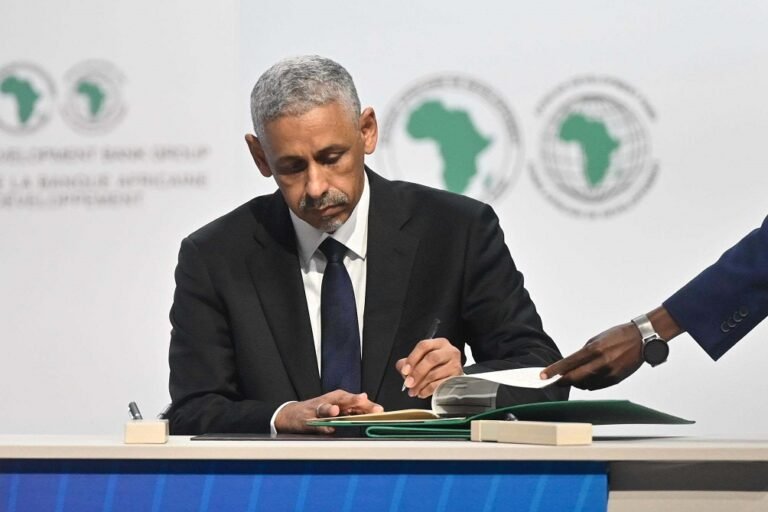
The African Development Bank will launch an initiative to help governments prepare for sovereign credit ratings by improving economic data and market transparency, President Sidi Ould Tah said on Thursday.
The remarks came from the S&P emerging markets conference in London, where Tah linked weak information systems to higher borrowing costs.
“What is missed in Africa is the data and the infrastructure… the opacity in some markets creates this notion of high risk, which leads to high cost of borrowing,” he said.
The programme will run through the African Legal Support Facility and is meant to help states meet the information demands of international rating agencies.
Tah said only three of Africa’s 54 countries are currently investment grade, underscoring limited access to cheaper external finance.
African officials have long argued that funding costs are unfairly high. The three major agencies say they apply the same methodologies worldwide.
The push coincides with a separate African Union-backed project. The African Peer Review Mechanism plans to launch the Africa Credit Rating Agency on 7 October in Mauritius.
AfCRA is designed as a commercially run, privately owned agency offering context-specific opinions, including on local-currency debt, without government shareholding.
A 2023 UNDP study, cited in recent coverage of the launch, estimated that rating “idiosyncrasies” cost Africa about $75 billion a year in extra interest and forgone lending.
Rating momentum has improved in places. An APRM mid-year 2026 review recorded foreign-currency upgrades for Cabo Verde, Ghana, Kenya, Nigeria and South Africa.
Botswana was cut by S&P from BBB to BBB- but remained investment grade after a sharp fall in diamond revenue. In September, Botswana was also downgraded by Moody to Baa2 from Baa1. Mozambique was also downgraded.
In June, Tah told Bloomberg he expected more countries to move toward investment grade by next year, after S&P restored Morocco’s status and lifted South Africa and Nigeria.
The AfDB projects continental growth of 4.4% next year, up from 4.2% this year, provided Middle East tensions do not intensify and raise energy costs.
Market pricing has eased from spring peaks. One June measure put the average African bond premium over US Treasuries at 304 basis points, down from 405.
An Africa Eurobond index was up 4.53% year to date by 21 September, led by Gabon, Zambia and Nigeria, according to MCB Capital Markets data.
Tah said the bank is also pressing domestic resource mobilisation, after talks with pension funds and banks on barriers to deeper local capital markets.
S&P has estimated that rated African sovereigns face about $90 billion in external principal repayments in 2026, keeping refinancing costs central to fiscal plans.
The AfDB itself retains AAA ratings from major agencies, supported by callable capital from non-regional shareholders, even as many of its borrowers remain below investment grade.