

For decades, Nigeria’s economic narrative has suffered from a paradox: it sat proudly among the world’s top producers of crude petroleum oil, yet remained chronically energy insecure. The country relied heavily on imported refined petroleum products—averaging 39% of merchandise imports—leaving its foreign exchange reserves, trade balance, and domestic manufacturing vulnerable to external shocks.
Today, that structural vulnerability is giving way to an unprecedented industrial transformation. At the center of this shift is the historic public offering of the Dangote Refinery and Petrochemical Plant (DRPP)—widely regarded as the largest corporate listing in African history.
Analyzing the dual roadmap presented during recent investor roadshows in Abuja by capital market authorities Prof. Uche Uwaleke and Prof. ‘Biodun Adedipe reveals that this IPO is far more than a standard stock market event. It is a structural re-engineering of Nigeria’s macroeconomy.
A Shield Against External Shocks
To understand the weight of the current listing, one must look at where the economy was. Seasonal fuel scarcities, unviable trade balances, and a heavy reliance on imported white products exposed the country to volatile global energy markets.
Prof. Adedipe points out that the operational maturity of the refinery served as a vital shock absorber when geopolitical conflicts disrupted global energy and fertilizer supply chains. By replacing imports with domestic production, Nigeria’s trade dynamics shifted dramatically.
Seaborne petroleum product exports have surged seven-fold since 2023, contributing to a robust trade balance of N20.15 trillion in the second half of 2026. This export-led inflow has provided steady support for the Naira and helped build external reserves to $54.823 billion.
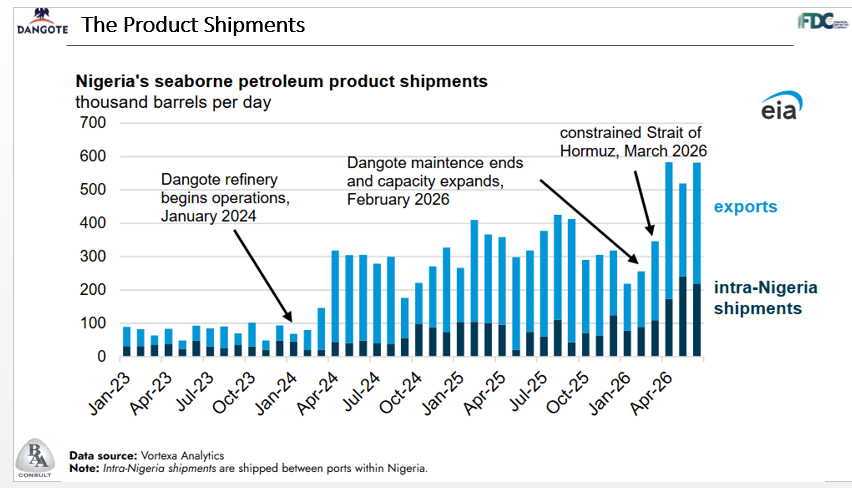
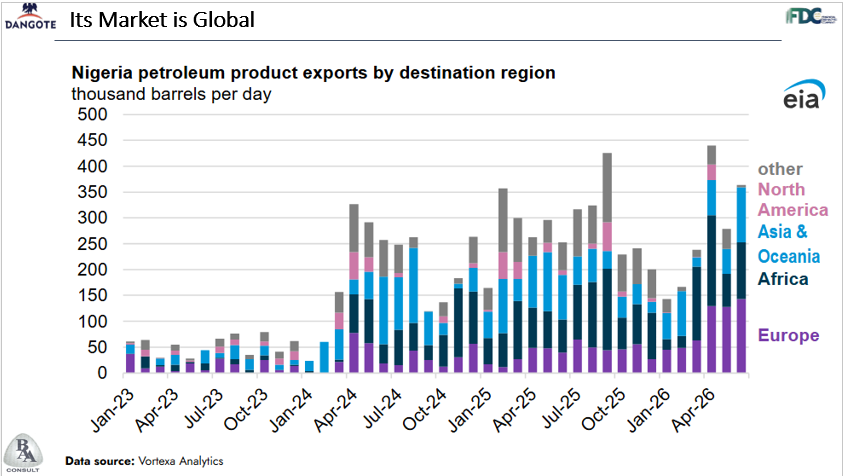
Building on this external strength, Prof. Uwaleke emphasizes that the refinery’s business model is anchored by a massive domestic demand base that provides a reliable baseline for cash flows. At the same time, surplus output targets regional African markets—such as ongoing projects in Kenya—and international buyers, effectively creating a hard-currency revenue stream that diversifies earnings beyond raw crude.
Scale, Integration, and Multi-Year Growth
The core investment proposition rests on deep industrial integration, functioning as an interconnected value platform spanning refining, petrochemicals, storage, marine logistics, and power.
The growth runway is substantial. The facility is positioned to scale its capacity from 700,000 barrels per day (bpd) toward an ambitious 1.4 million bpd by around 2029. Prof. Uwaleke notes that this expansion, coupled with a first-half 2026 profit reported at approximately US$1.82 billion, gives the equity story a multi-year horizon rather than a short-lived market splash.
This operational scale triggers a powerful multiplier effect across the entire economic chain. According to impact projections highlighted by Prof. Adedipe, local refining lowers domestic energy costs, which in turn reduces production expenses for local manufacturers, stimulates investment, and is estimated to boost overall GDP growth by 2.06 percentage points. Furthermore, the complex acts as a job-creation engine, supporting over 100,000 direct jobs and more than 2.2 million indirect positions across engineering, maritime services, logistics, and maintenance.
Democratizing Wealth and Market Depth
For the everyday Nigerian, the most revolutionary aspect of the IPO is accessibility. Structured around 4.1 billion ordinary shares at an offer price of N525 per share, the transaction features a low entry threshold of just 10 shares—amounting to N5,250.
Prof. Uwaleke stresses that this pricing strategy effectively bridges the gap between consumers and co-owners, enabling millions of retail investors to transition from passive bank depositors to active participants in wealth creation.
From a capital market perspective, the listing is a monumental milestone. Tilewa Adebajo of The CFG Advisory notes that the combined valuation of the Dangote equity cluster will create a listed group worth roughly ₦83.5 trillion, describing it as “a Landmark and Historic listing” that will materially alter exchange liquidity and index concentration.
Navigating Risks with a Long-Term View
While the macroeconomic indicators are compelling, normal equity and sector risks—such as crude supply arrangements and complex plant operations—require careful monitoring. Prof. Uwaleke advises investors to read the final prospectus closely and invest with a long-term, diversified mindset.
Ultimately, Prof. Adedipe’s report Highlights that: “The Dangote Refinery could be one of the most consequential private-sector investments in Nigeria’s economic history… Its deeper significance is the possibility of changing Nigeria’s economic model: From crude-oil exporter → refined-product producer → petrochemical producer → industrial economy.”