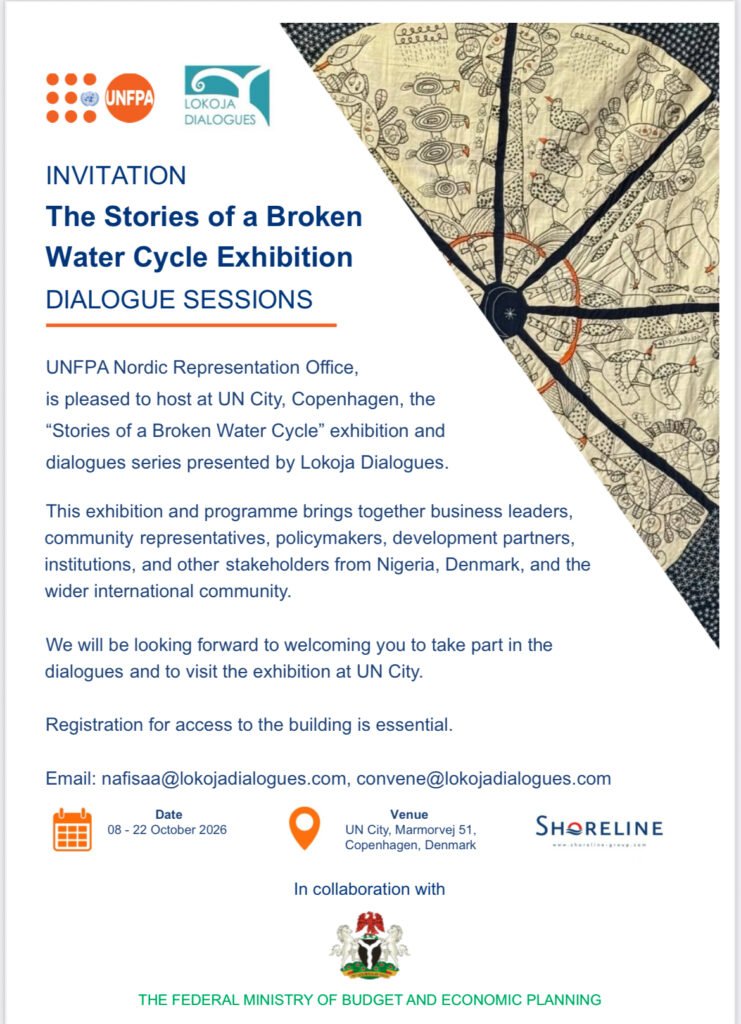
From 8 to 22 October 2026, UNFPA’s Nordic Representation Office will host “The Stories of a Broken Water Cycle” at UN City, Marmorvej 51. Lokoja Dialogues is presenting the exhibition and a series of dialogue sessions.
The programme is meant to bring together business leaders, community representatives, policymakers, development partners and institutions from Nigeria, Denmark and elsewhere. The Nigerian Ministry of Budget and Economic Planning is named as a collaborator alongside Shoreline as a sponsor.
At Copenhagen, the collections on display are not for sale.
Access to the building requires registration. Enquiries are being directed to nafisaa@lokojadialogues.com and convene@lokojadialogues.com.
The figures behind the work are stark. 15 of Nigeria’s 36 states are losing ground to desertification. In some of the hardest-hit places, people get as little as nine liters of water a day. Less than 10% of land that could be irrigated is actually used. The Emir of Argungu, Alhaji Samaila Muhammed Mera, has said that “If nothing is done, life as we know it in these communities will cease to exist”.
Water shortages are already a political problem as well as a household one. Forecasts put the number of people who could be pushed from their homes by water scarcity at up to 700 million worldwide by 2030. Around the Lake Chad Basin, fights over water have already turned violent. Some research says fixing regional water shortfalls could add as much as 6% a year to growth.
Lokoja Dialogues is an independent non-profit platform dedicated to strengthening Nigeria’s water and climate resilience by connecting grassroots realities with national policy. Spearheaded by key promoters including Founder Polly Alaina and Co-founder Adwoa Edun, the initiative collaborates with local communities and traditional leaders to convert regional water challenges into sustainable, long-term solutions.
In August, Lokoja Dialogue held its Inaugural Lagos dialogue, gathering together policymakers, investors and water-sector practitioners to deliberate and offer solutions to Nigeria water problems.