
IMF Demands Tough Economic Reforms From Malawi Before Finalizing Rapid Credit Deal
The International Monetary Fund (IMF) is ready to fast-track a credit programme for Malawi, but warned Monday that the funding depends heavily on the government’s willingness to implement structural economic reforms. Discussions are currently centered on an Extended Credit Facility arrangement to anchor Malawi’s newly introduced National Economic Recovery Plan, according to IMF Resident Representative Nelnan Koumtingue. The announcement followed an IMF mission that left the Southern African nation on June 18 without finalizing a concrete deal, leaving the immediate timeline for financial relief uncertain. “The process is evolving,” Koumtingue stated, emphasizing that ongoing negotiations require clear policy commitments to stabilize public finances before the lender can disburse any capital. A previous $175 million IMF credit facility collapsed in May 2025 because Malawi failed to complete its formal program review within 18 months, securing only a $35 million initial disbursement. Finance Ministry spokesperson Williams Banda confirmed that the government and the lender have agreed on a general pathway forward, though he declined to outline specific operational or fiscal benchmarks. Malawi’s five-year recovery plan aims to tackle a severe debt burden, currently estimated at 91% of GDP, alongside acute foreign exchange shortages and inflation hovering around 28%.
Stablecoin Surge: Nigeria Emerges as Sub-Sahara Africa’s $59B Crypto Hub

LAGOS — Nigeria has become Sub-Saharan Africa’s dominant crypto market, pulling in $59 billion in inflows between July 2023 and June 2024, driven heavily by dollar-pegged stablecoins, the International Monetary Fund (IMF), said on Tuesday. According to the IMF report “Stablecoins in Nigeria- A Growing Cross-Border Channel”, the country now accounts for roughly 60% of all stablecoin inflows into the region since 2019. The explosive growth positions Nigeria second globally on Chainalysis’s Crypto Adoption Index, as citizens increasingly ditch the local currency for digital dollars to hedge against inflation. “What began as a niche technology has become a meaningful cross-border payments channel. Its rapid growth is easing long-standing frictions in cross-border transactions.” IMF noted. High traditional remittance fees, averaging 9% in Sub-Saharan Africa, and persistent foreign exchange illiquidity in official banks have forced households and businesses into decentralized peer-to-peer networks. While these digital tokens offer cheap, near-instant cross-border transactions, the IMF warns they trigger severe “digital dollarization,” which threatens Nigeria’s monetary sovereignty and weakens domestic policy transmission. The migration of massive financial volumes away from traditional banks into private digital wallets also complicates financial oversight, escalating potential money laundering and illicit finance risks. To counter this, the IMF urges Nigerian authorities to enforce tighter monetary policy to stabilize the naira, alongside deploying blockchain analytics to monitor crypto-to-fiat conversion points. The report emphasizes that suppression will not work, advising regulators to instead upgrade national payment infrastructures to directly compete with stablecoins on speed and transaction costs.
IMF Approves $266 Million for Liberia’s Climate Resilience and Economic Stability
The International Monetary Fund (IMF) has approved a $266 million arrangement for Liberia under the Resilience and Sustainability Facility to strengthen the nation against climate change. The Executive Board’s decision, announced Monday, April 27, 2026, includes an immediate disbursement of $26.49 million to bolster the country’s fiscal buffers and support ongoing economic reforms. This funding follows the successful completion of the third review under the Extended Credit Facility (ECF). Total disbursements under the ECF, initiated in 2024, now reach $105.96 million. IMF officials cited Liberia’s strong macroeconomic performance as a primary factor for the approval. The nation’s economy grew by 5.1% in 2025, with similar growth projected for 2026. The new 21-month RSF program specifically targets structural vulnerabilities. It aims to improve pandemic preparedness and integrate climate-related risks into Liberia’s broader fiscal and monetary policy frameworks. While the outlook remains positive, the IMF cautioned that Liberia must remain committed to debt sustainability. Managing inflation and improving governance are critical to maintaining the current growth trajectory. Recent context shows Liberia navigating a complex recovery following the global shocks of previous years. The government has focused on infrastructure and agriculture to reduce dependency on costly imports. This latest financial injection is expected to stabilize the Liberian dollar and provide the necessary capital for green energy projects, which are essential for the country’s long-term environmental strategy. The IMF noted that despite global volatility, Liberia’s disciplined fiscal approach has kept the budget deficit manageable. Continued international support remains vital for achieving the “ARREST” agenda goals.
Nigeria’s economic chiefs meet World Bank president to bolster reform support
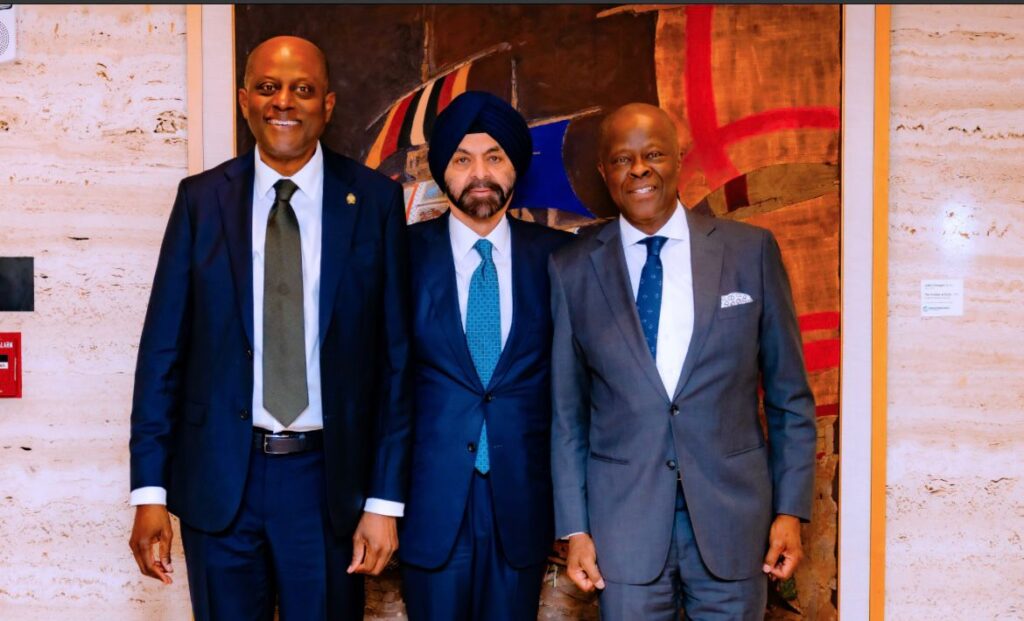
Nigeria’s top economic team met with World Bank President Ajay Banga on Tuesday to solidify strategic partnerships and seek support for the nation’s ongoing macroeconomic reforms during the 2026 IMF/World Bank Spring Meetings. Central Bank of Nigeria (CBN) Governor Olayemi Cardoso and the Minister of Finance and Coordinating Minister of the Economy, Wale Edun, held the high-level talks at the World Bank headquarters to align Nigeria’s fiscal and monetary trajectories with international development goals. The engagement comes at a critical juncture as Nigeria manages a projected debt-to-GDP ratio of 34.5% and continues its push for currency stability. The meeting focused on deepening cooperation in areas of infrastructure financing, technical support for monetary policy, and social safety nets designed to cushion the impact of recent economic shifts. While specific financial commitments were not immediately disclosed, the presence of both the CBN Governor and the Finance Minister underscores a unified front in addressing Nigeria’s liquidity challenges and inflation targets. Discussions are believed to have touched upon Nigeria’s industrial expansion and the institutionalization of regional real estate and energy markets, which remain central to the government’s growth agenda for 2026. By engaging directly with Banga, the delegation aims to boost investor confidence and de-risk the Nigerian debt capital market for global institutional players. Same Tuesday, Wale Edun, chairing the Group of Twenty-Four (G24) Ministerial Meeting on the sidelines of the World Bank Group Spring Meetings, demanded urgent multilateral support to shield developing nations from heightening global economic instability and geopolitical shocks. The Spring Meetings continue through the week, with the Nigerian delegation expected to participate in further sessions regarding private sector activity across West Africa and global energy benchmarks.
4.1%:IMF cuts Sub-Saharan Africa growth outlook amid geopolitical tensions and debt Strain
The International Monetary Fund (IMF) has lowered Sub-Saharan Africa’s 2026 growth forecast to 4.3 percent on Tuesday. This revision reflects deepening concerns over geopolitical tensions and persistent domestic fiscal constraints across the continent. According to its latest “World Economic Outlook” Global economic recovery remains steady but underwhelming. Rising Middle East conflicts have disrupted energy markets, forcing many African nations to grapple with renewed inflationary pressures and fluctuating commodity prices. “Growth in sub-Saharan Africa is expected to be relatively stable at 4.3 percent in 2026 and 4.4 % in 2027. This masks variation across countries, with some in the region— particularly oil-importing non-resource-intensive countries-adversely affected by the Middle East conflict,” the report stated. Nigeria stands as a resilient outlier among its regional peers. Growth for Africa largest oil exporter was downgraded to 4.1% from 4.4%. The Fund cited sustained domestic reforms and a strengthening services sector. In contrast, South Africa continues to struggle with structural bottlenecks. Its projected growth of 1.4%. “In Nigeria, growth momentum is sustained at 4.1 percent in 2026, supported by improved macroeconomic stability and positive terms-of-trade effects, while higher goods.” IMF noted. Debt servicing remains a critical “fiscal trap” for African policymakers. The ratio of external debt service to revenue has doubled since 2017, now consuming 18 percent of available funds. Public capital investments are currently 20 percent below 2014 levels. Governments are increasingly forced to prioritize high-interest debt payments over essential infrastructure projects like power grids and transportation networks. IMF Latest Projections Region / Indicator January 2026 Forecast April 2026 Forecast Change (Percentage Points) Global Growth 3.3% 3.1% -0.2 Sub-Saharan Africa 4.6% 4.3% -0.3 Nigeria 4.4% 4.1% -0.3 South Africa 1.4% 1.4% 0.0 Global Inflation 3.8% 4.4% +0.6 source: IMF Globally, growth Now projected at 3.1% for 2026 (a slight downward revision from the 3.3% projected earlier this year). The 2027 forecast remains at 3.2%. Also, global headline inflation is cooling but remains a sticky challenge. It is expected to drop to 3.8% in 2026, down from 4.1% in 2025. Regional inflation is expected to remain sticky at 4.8 percent through 2026. Frequent currency depreciations and high imported energy costs continue to complicate the path for various central banks. The IMF urges African leaders to rebuild fiscal buffers immediately. Escaping the “low-growth trap” requires a strategic pivot toward digital ICT, renewable energy, and increased intra-regional trade.