


When PwC’s Global AI Jobs Barometer dropped its analysis of over one billion job postings across six continents, it delivered a lethal blow to the prevailing economic panic: Artificial Intelligence (AI) is not an automated executioner for human employment.
Instead of hollowing out payrolls, the empirical data exposes a startling corporate reality. As the report notes, “Rather than simply replacing jobs, AI is reshaping them in fundamentally different ways.” Rather than shrinking, the market leaders most aggressively exposed to AI automation are expanding their headcounts significantly faster than laggards.
The Super-Star Productivity Dividend
The panic over job loss fundamentally misunderstands how technology transforms markets.
According to PwC, the top 20% of companies most heavily leveraging AI recorded a staggering 163% surge in labor productivity. Rather than pocketing those efficiency gains through cold-blooded downsizing, these corporate giants saw a 52% headcount growth rate, easily outpacing the 36% growth registered by companies least exposed to AI.
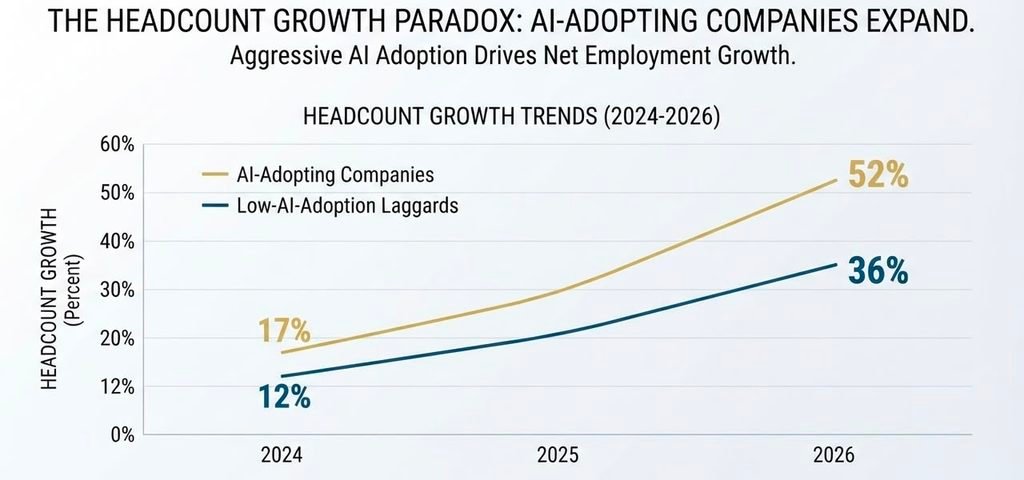
As highlighted in the analysis, “The companies achieving the biggest productivity gains from AI are not using it only to cut costs. Instead, they use AI to amplify human performance and create new forms of value.” When algorithms absorb high-frequency administrative friction—data parsing, basic scheduling, and routine document sorting—operating costs drop.
This efficiency unlocks capital, allowing businesses to scale into new markets, launch novel products, and hire humans for higher-level work that previously did not exist.
The Rise of the “Professionalised” Workforce
AI is not eliminating roles; it is reshaping the labor market into a two-track ecosystem where human judgment becomes the ultimate currency. PwC’s data shows that “professionalised” roles—where technology handles routine drudgery, freeing professionals to double down on empathy, strategic oversight, and complex evaluation—are growing twice as fast as roles flattened or “democratised” by software.
The economic rewards match the shift.
Workers who integrate specialized AI competencies into their daily routines command an average 62% wage premium over unaugmented peers. In competitive sectors like consumer markets, that premium spikes past 100%. The market is not paying humans less; it is paying handsomely for those who can pilot tools to amplify output.
The African Growth Angle: Leapfrogging and Skill Demand
Across emerging markets like Africa, the narrative mirrors this global evolution with a unique twist. Regional insights tracking economies such as South Africa demonstrate that even amid tighter macro-labor conditions, the share of job advertisements demanding AI-related skills has accelerated significantly.
Rather than facing job scarcity, sectors adopting AI-driven augmentation are seeing structural demand rise for higher-level qualifications and human-centered skill sets. For developing business hubs across the continent, AI is functioning as a critical multiplier—compressing decades of procedural lag and allowing local professionals to bypass legacy inefficiencies straight into high-value market participation.
Compressing the Career Ladder
For young professionals, the traditional anxiety is that AI closes the door on entry-level apprenticeship. The data proves the exact opposite. Entry-level positions heavily exposed to AI are now seven times more likely to demand traditionally senior-level competencies like leadership, strategic judgment, and stakeholder negotiation.
These “seniorised” entry-level roles have climbed 35% over recent years, forcing organizations to accelerate talent development. Rather than locking beginners out, technology acts as an accelerator, pushing workers into high-impact strategic thinking years earlier in their careers.
Adapt, Don’t Panic
Economic history repeats a consistent pattern: technology replaces tasks, never entire jobs. The steam engine automated muscle; personal computers automated accounting ledgers. Each shift felt catastrophic in real time, yet each transition ultimately created multi-trillion-dollar industries and entirely new employment classes.
Artificial intelligence is simply the next iteration of this cycle. The offices emptying out aren’t being cleared by algorithms—they are being transformed by professionals who have figured out a fundamental truth of the modern economy: you aren’t going to lose your job to an AI. You are going to lose it to a human who knows how to use one.