
Recent public commentary has portrayed President Bola Ahmed Tinubu as Nigeria’s most aggressive borrower since the return to democracy in 1999. Some commentators have even suggested that the current administration has borrowed more than all previous democratic administrations combined.
However, the available evidence does not support these conclusions.
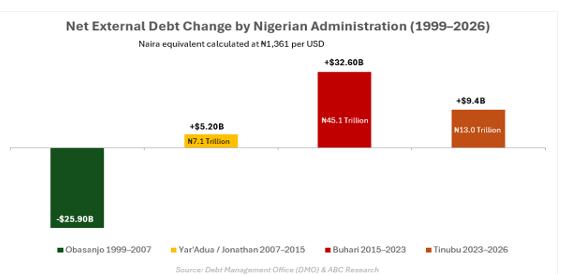
Nigeria’s external debt stock stood at approximately $42.5 billion when President Tinubu
assumed office in May 2023. By December 2025, it had risen to approximately $51.9 billion, representing a net increase of around $9.4 billion. By contrast, Nigeria’s external debt increased from approximately $10.3 billion in 2015 to $42.9 billion by 2023, representing a net addition of about $32.6 billion during the Buhari administration.
The evidence therefore indicates that the largest increase in Nigeria’s external debt stock in the democratic era occurred between 2015 and 2023.
The perception of unprecedented borrowing under the current administration stems largely from the revaluation of inherited foreign-currency obligations following the June 2023 exchange-rate adjustment. At the same time, Nigeria faces a genuine fiscal challenge. Rising debt-service obligations accumulated over many years continue to constrain fiscal space for infrastructure, healthcare, education, security, and other critical expenditures.
Key Takeaways
- President Tinubu is not Nigeria’s largest borrower since the return to democratic rule in 1999.
- Claims that the current administration has borrowed more than all previous administrations
combined are inconsistent with available dollar-denominated debt data. - Much of the apparent increase in Nigeria’s debt stock in naira terms reflects the exchange-rate
revaluation of inherited foreign-currency obligations, rather than equivalent new borrowing. - In dollar terms, Nigeria’s domestic debt declined by about $6.5 billion under the current
administration, and total public debt rose by only around $2.7 billion between Q1 2023 and Q4
- The most significant fiscal constraint facing Nigeria today is debt service, which absorbs a
substantial proportion of government revenues.
Figure 1: Borrowing under different administrations since 1999 in US $.
Source: Data from Debt Management Office.
- Why Naira Debt Figures Can Mislead – External debt obligations are contracted and repaid in foreign currency. As such, dollar-denominated measurements provide the most consistent basis for comparison across administrations.
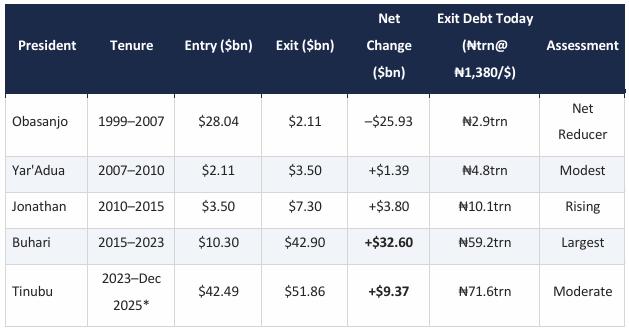
Following exchange-rate unification in June 2023, the naira depreciated significantly against the US dollar. This had a substantial accounting effect on the domestic valuation of Nigeria’s external debt stock. The approximately $42.5 billion inherited by the current administration was valued at around ₦19.6 trillion under the previous exchange-rate regime. After revaluation at market exchange rates, the same stock appeared substantially larger in naira terms.
This increase did not arise because the government borrowed tens of trillions of naira in new external obligations. Rather, it reflected the translation effect of applying a weaker exchange rate to an existing stock of foreign-currency debt.
Comparing debt figures expressed in naira before and after exchange-rate adjustment, without controlling for these valuation effects, creates a misleading impression of debt accumulation.
Figure 2: Presidential Debt Ledger showing start, end, net change, and all debts in Current Naira values.
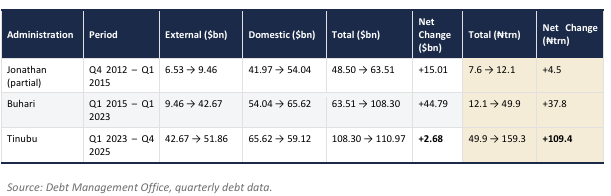
- Inside Nigeria’s Domestic Debt Story – Most of the criticism around Tinubu’s borrowing record has centred on external debt, but the domestic figures add important context. In dollar terms, domestic debt eased from about $65.6 billion in Q1 2023 (Buhari era) to $59.1 billion by end 2025 (Tinubu era), a decline of roughly $6.5 billion. That sits against an increase of around $11.6 billion during the Buhari years. When you put domestic and external debt together, total public debt rose by only about $2.7 billion in dollar terms between Q1 2023 and Q4 2025, even though
the naira headline rose by roughly ₦109.4 trillion over the same period. Both figures are correct, but only the dollar measure reflects actual new borrowing.
Between Q1 and Q2 2023, the naira value of external debt rose from ₦19.6 trillion (Buhari) to ₦33.2 trillion (Tinubu) with little change in dollar terms, reflecting exchange rate unification and revaluation of existing debt. In the same period, domestic debt increased from ₦30.2 trillion (Buhari) to ₦54.1 trillion (Tinubu), driven primarily by the securitization and balance sheet recognition of ₦23.9 trillion in Ways and Means advances; previous Central Bank overdrafts accumulated under Buhari and subsequently converted into marketable government debt instruments. These movements represent accounting reclassification and stock revaluation adjustments, not incremental fiscal borrowing flows.
Excluding the Ways and Means securitization, about ₦30.7 trillion in net new domestic issuance has been recorded since mid-2023. However, the dollar decline in domestic debt reflects exchange rate depreciation and valuation effects, which mechanically reduce the foreign currency equivalent of naira-denominated liabilities. Overall, exchange-rate pass-through effects account for most of the volatility in debt figures, while the underlying increase in net new borrowing is materially smaller than the naira aggregates suggest.
Figure 3: Nigeria’s Public Debt by Administration: Entry, Exit, and Net Change
- The Real Fiscal Challenge is Debt Service – Nigeria’s debt challenge is increasingly defined not by the size of the debt stock but by the cost of servicing it. Debt-service obligations consume a significant proportion of government revenues, limiting the resources available for development priorities. Rising debt-service obligations reduce fiscal space for growth-enhancing investments.
The country’s debt-service burden reflects:
- obligations accumulated over multiple administrations;
- repayments associated with Eurobond issuances;
- bilateral and multilateral financing commitments;
- domestic debt obligations; and
- the higher naira cost of servicing foreign-currency debt following exchange-rate reforms.
The consequences are significant. As debt-service commitments consume a larger share of government revenues, the fiscal space available for critical investments becomes increasingly constrained. Debt-service obligations have emerged as the primary constraint on fiscal sustainability.
This affects the government’s capacity to fund:
- roads and transport infrastructure;
- power projects;
- education;
- healthcare;
- security operations; and
- social intervention programmes.
- Conclusion – A careful review of the evidence suggests that Nigeria’s debt narrative requires greater nuance. President Bola Ahmed Tinubu cannot accurately be described as the largest borrower of Nigeria’s democratic era based on internationally comparable dollar-denominated metrics.
The sharp increase in naira debt figures since 2023 reflects, in significant part, the exchange-rate revaluation of inherited foreign-currency obligations rather than equivalent new borrowing. At the same time, Nigeria’s debt challenge should not be minimized.
The country’s debt-service burden places substantial pressure on public finances and limits the government’s capacity to invest in infrastructure and human development. The national conversation should therefore move beyond simplistic headline figures toward a more constructive discussion about:
- debt sustainability;
- revenue mobilisation;
- fiscal discipline;
- refinancing strategies; and
- ensuring that public borrowing supports long-term economic growth.
A fact-based assessment of Nigeria’s debt profile leads to one clear conclusion: the central challenge facing Nigeria today is not merely how much has been borrowed, but how inherited obligations, debt-service pressures, and limited revenues constrain the country’s development ambitions.