

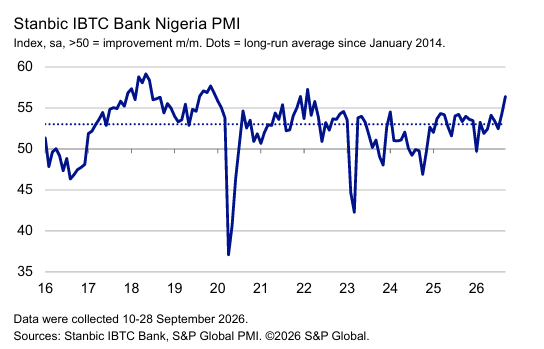
Nigerian private sector business conditions strengthened significantly as the headline Purchasing Managers’ Index climbed to 56.4 in September 2026, up from 54.3 in August.
According to the Stanbic IBTC Bank Nigeria report released on Friday, this performance marks the strongest growth trajectory recorded across the country in over four and a half years.
Readings above 50.0 signal an improvement in business conditions on the previous month, while readings below 50.0 show a deterioration.
The acceleration was propelled by new orders, which expanded for an eighth consecutive month at the fastest pace since February 2022.
Customer demand and product rollouts drove broad-based output expansions across all four monitored sectors, lifting corporate optimism for the coming year.
To manage expanding workloads, firms aggressively scaled up purchasing activity, triggering the sharpest inventory accumulation since late 2021 alongside a 16th consecutive month of job growth.
Operating expenses climbed to a three-month high due to persistent fuel, food, and raw material pressures, compelling businesses to pass costs onto consumer prices.
“Elsewhere, higher fuel prices continue to feed into increase in transport costs. This, in addition to increase in raw material prices, rising staff costs, as well as the prices of other food products helped to ensure that input costs maintained their uptrend.
“This then fed into output prices increasing to a three-month high in September.” Muyiwa Oni, Head of Equity Research West Africa at Stanbic IBTC Bank said.
This economic momentum parallels broader macroeconomic gains, including cooling headline inflation rates, strengthening foreign exchange reserves at $54 billion in September, and expanding non-oil sector output.