
Policy Research and Analysis.
| Executive Summary
The proposed amendment to the Customs, Excise Tariff, Etc. (Consolidation) Act (CETA) would replace the existing ₦10 per litre excise on sugar-sweetened beverages (SSBs) with an ad valorem tax. At prevailing prices, the proposed change would significantly increase the tax burden on SSBs and alter how the excise is assessed. This report examines the proposed reform in the context of Nigeria’s health, economic and fiscal conditions. It considers the design of the proposed tax, evidence on the health effects of SSB taxation, the potential impact on the beverage sector and households, and the revenue performance of the existing excise. The health objective of reducing excessive sugar consumption is recognised. However, Nigeria’s relatively low per-capita sugar consumption needs to be considered alongside other nutritional and socioeconomic challenges. More than 133 million Nigerians are also living in multidimensional poverty, while households continue to face weak purchasing power and higher living costs. These conditions make the potential effects of higher SSB prices on household welfare and consumption important to the assessment. The report also reviews international experience with different SSB tax structures. Evidence from other countries shows that SSB taxes can reduce purchases, but the design of the tax influences its administrative requirements, effects on prices and incentives for product reformulation. These lessons are relevant as Nigeria considers moving from a specific excise to an ad valorem structure. The analysis finds that the proposed reform raises questions around tax administration, the strength of the health evidence, sector and household effects, and transparency around the existing excise revenue. These issues should be considered alongside the objectives of Nigeria’s 2026 tax reforms, particularly the emphasis on simpler and more predictable taxation.
|
1. Introduction
The proposed amendment to the Customs, Excise Tariff, Etc. (Consolidation) Act (CETA) would replace Nigeria’s existing ₦10 per litre excise duty on sugar-sweetened beverages (SSBs) with an ad valorem excise duty. The Senate passed the bill at Third Reading on 4 June 2026. The bill was subsequently transmitted to the House of Representatives for concurrence and, as of the time of this report, has not been enacted into law. Corporate Accountability and Public Participation Africa (CAPPA) estimates that the proposed reform could raise the effective SSB tax burden to approximately ₦130 per litre, based on prevailing retail prices, compared with the existing ₦10 per litre excise duty.
The reform seeks to reduce sugar consumption, strengthen healthcare financing, align Nigeria’s fiscal framework with global practice, and restore the value of the existing excise, which has been eroded by inflation since its introduction in 2022. The extent to which these objectives can be achieved will depend on the design and implementation of the tax, as well as the economic environment in which it is introduced.
Businesses and households are already facing rising production costs, foreign exchange constraints, inflationary pressures, and weaker purchasing power. A substantial increase in the tax could therefore have implications for consumption, production, employment, investment, household welfare, and government revenues.
The report assesses the reform across four areas: administrative feasibility, health outcomes, economic and distributional effects, and fiscal transparency and policy coherence. It considers whether the proposed tax can achieve its health and revenue objectives while remaining proportionate to Nigeria’s broader economic and social priorities.
2. Proposed Tax Changes and Industry Views
The beverage industry’s concerns centre on the structure and scale of the proposed tax increase, rather than on the use of excise taxation itself. The industry argues that moving from the existing ₦10 per litre excise to an ad valorem structure could substantially increase the tax burden, while adding uncertainty around valuation and compliance.
Under the 2022 framework, SSBs are subject to a fixed ₦10 per litre excise based on production volume, making the tax relatively straightforward to administer using production records. The proposed CETA amendment would replace this with an ad valorem excise based on product value. This would require greater reliance on price determination, valuation, monitoring and enforcement, while making the tax burden more sensitive to changes in retail prices.
The industry is concerned that the proposed structure and rate could increase production costs and retail prices in an already difficult operating environment. It has also raised concerns about the potential effects on consumer demand, production, employment and investment across the value chain. Its position is therefore centred on the design and magnitude of the proposed increase, rather than opposition to SSB taxation itself.
At the same time, the industry has introduced measures aimed at reducing sugar consumption, including product reformulation, expansion of zero- and low-sugar products, and investment in research and innovation. These measures suggest that changes in product composition and consumer choice are already taking place alongside the existing excise and should be considered when assessing the additional benefits and costs of the proposed reform.
Table 1: Nigeria’s Current and Proposed SSB Excise
| Feature | Current system | Proposed system |
| Tax structure | Specific excise | Ad valorem excise |
| Tax base | Production volume | Product value |
| Rate | ₦10/litre | Effective burden of about ₦130/litre* |
| Price sensitivity | Low | High |
| Administration | Production-volume records | Price valuation and monitoring |
| Sugar-content differentiation | None | None |
As shown in Table 1, the proposed reform changes both the level and basis of taxation. The current excise is linked to production volume, while the proposed system would make tax liability dependent on product value. This has implications for the predictability of the tax burden, price-setting and the administrative requirements for both businesses and tax authorities.
3. Economic and Sectoral Implications
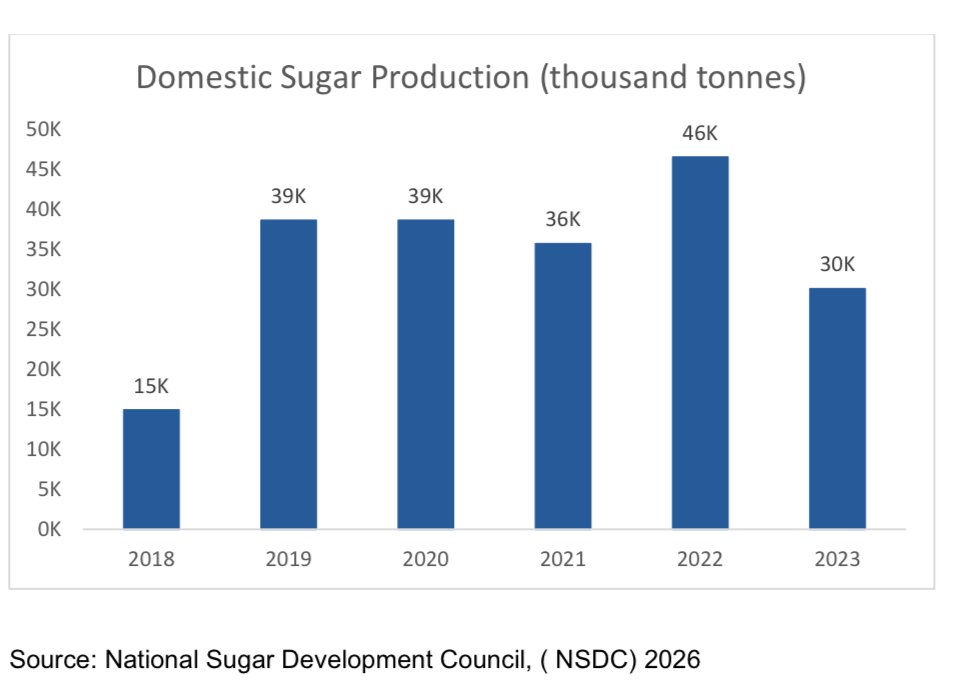
Nigeria has one of Africa’s largest SSB markets, with a value chain spanning manufacturing, agriculture, logistics and retail. The Manufacturers Association of Nigeria (MAN) estimates that approximately 1.5 million jobs depend directly or indirectly on the sector. The beverage industry is also closely linked to the wider sugar market, with about 80 percent of domestic sugar consumption used in food and beverage manufacturing. Nigeria remains heavily dependent on imported sugar, importing an estimated 1.4–1.7 million metric tonnes of refined sugar annually.
Figure 1a: Nigeria’s Sugar Consumption and Imports, 2018–2023
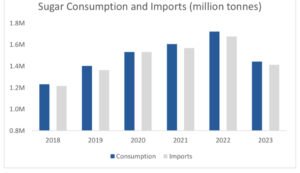
Figure 1a shows that Nigeria’s sugar consumption and imports increased between 2018 and 2022 before declining in 2023, underlining the market’s heavy dependence on imported sugar.
Figure 1b: Nigeria’s Domestic Sugar Production, 2018–2023
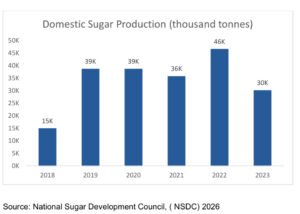
Figure 1b shows that domestic sugar production followed a broadly similar pattern over the period but remained consistently and substantially below the volumes shown in Figure 1a, so that domestic output covers only a small share of total consumption, reinforcing the sector’s reliance on imports.
Sugar Market and Sector Performance Since 2022
Since the introduction of the ₦10 per litre SSB excise in 2022, the sector has operated amid significant economic pressures. Data from the National Sugar Development Council (NSDC) show that total sugar consumption declined by approximately 16 percent, from 1.72 million tonnes in 2022 to 1.44 million tonnes in 2023. Domestic sugar production also fell by about 35 percent, from 46,479 tonnes to 30,053 tonnes over the same period.
These changes occurred alongside inflation, exchange-rate pressures, rising input costs and weaker household purchasing power and therefore cannot be attributed to the SSB excise alone. They nevertheless provide important context for assessing the potential effects of a further increase in the tax burden.
| Key Takeaway
The SSB sector is already adjusting to a constrained demand environment under the current tax, and further fiscal escalation would amplify existing pressures on output, employment, and investment. The proposed increase therefore represents a material downside risk to an industry that has not yet recovered to its pre-2022 performance levels. |
- Economic Impact of the Proposed Tax
The proposed increase in the SSB excise could have effects beyond the direct tax burden on beverage manufacturers. Higher taxation could translate into higher retail prices, lower demand and adjustments in production, with possible implications for employment and investment across the value chain.
A simulation analysis cited in Corporate Accountability and Public Participation Africa (CAPPA) estimates that increasing the SSB tax to ₦130 per litre could increase retail prices by approximately 39 percent and reduce annual per-capita SSB consumption by about 29 percent. These estimates are based on modelling rather than observed post-tax outcomes and should therefore be interpreted as scenario estimates.
The same modelling estimates that annual industry output could decline from approximately ₦1.5 trillion to ₦1.1 trillion by 2030 under the ₦130 per litre scenario. The model also projects a decline in the production index from 78 to approximately 40. These results suggest that the proposed increase could create a significant adjustment for the sector if the assumptions underlying the model materialise.
5. International Evidence on SSB Tax Design
Countries have adopted different approaches to taxing sugar-sweetened beverages, including volume-based specific taxes, sugar-content-based taxes, ad valorem taxes and mixed systems. The choice of structure matters because each approach creates different incentives for consumers, manufacturers and tax authorities. The World Bank classifies SSB taxes according to their tax base and rate structure, while the WHO distinguishes volume-based specific, sugar-content-based specific and ad valorem excises.
Table 2: International SSB Tax Structures and Country Examples
| Tax structure | Country examples | How it works | Key implication |
| Uniform ad valorem | Rwanda, Barbados, Saudi Arabia, UAE | Fixed percentage of product value | Simple percentage-based structure, but tax burden varies with product price |
| Tiered ad valorem | Chile, Peru | Different rates based partly on sugar content | Can provide incentives for lower-sugar products |
| Volume-based specific | Mexico, Malaysia | Fixed amount per litre/volume | Predictable and relatively simple to administer |
| Sugar-content specific | UK, South Africa, Mauritius | Tax linked directly to sugar content | Stronger incentive for reformulation |
| Mixed/hybrid | Ecuador, Mexico and others | Combines ad valorem and/or specific components | Can balance revenue and health objectives but may increase complexity |
Source: World Bank Global SSB Tax Database; WHO Global Report on the Use of Sugar-Sweetened Beverage Taxes, 2025
As shown in Table 2, the main distinction is the basis on which the tax is calculated. Volume-based taxes apply a fixed amount to the quantity of beverage sold, while sugar-content taxes link the tax directly to the amount of sugar in the product. Ad valorem taxes instead apply a percentage to product value. WHO notes that the base used for an ad valorem tax can vary from the manufacturer’s price to wholesale or retail values, making the choice of valuation base important for administration.
5.1.1 Rwanda: What Nigeria Can Learn from a 39% Ad Valorem Excise
Rwanda applies a 39% ad valorem excise duty to lemonades, sodas and other non-natural juices. The tax is based on the value of the product rather than its volume or sugar content.
The experience, however, shows that a high tax rate does not automatically translate into a strong health outcome. Rwanda’s 39% excise was introduced primarily as a revenue measure and applies to both sugary and non-sugary soft drinks. As a result, it does not distinguish between beverages according to their sugar content and provides little incentive for manufacturers to reformulate products to reduce sugar. Research on Rwanda has therefore questioned whether the existing structure is sufficient to reduce SSB consumption.
For Nigeria, the main lesson is that the tax base matters as much as the tax rate. An ad valorem system can raise the price of beverages and generate government revenue, but if the same rate applies regardless of sugar content, it may be less effective in encouraging healthier product choices. Nigeria could therefore consider whether the proposed value-based system should be complemented by sugar-content thresholds or differentiated rates if health and product reformulation are key objectives.
Rwanda shows that a high ad valorem rate can work as an excise revenue instrument, but its public-health effect can be limited when the tax does not distinguish between high- and low-sugar beverages.
5.1.2 South Africa: Linking the Levy to Sugar Content
South Africa adopted a different approach through its Health Promotion Levy (HPL) in 2018. The levy is based directly on sugar content: 2.1 cents per gram of sugar above 4 grams per 100 ml. This makes the tax higher for beverages with more sugar and creates an incentive for manufacturers to reformulate their products.
Evidence from South Africa shows reductions in both SSB purchases and sugar consumption. A 2025 study using manufacturers’ and importers’ excise data estimated a 33 percent reduction in sugar from taxable beverages within two years, although consumption of non-taxable SSBs increased by 15 percent, indicating some substitution.
For Nigeria, South Africa provides a useful alternative to a uniform ad valorem system. Linking the tax directly to sugar content makes the health objective more explicit and provides an incentive for reformulation, while the experience also shows the importance of monitoring substitution and ensuring broad coverage of the tax base.
6. Health Evidence: What SSB Taxes Can and Cannot Achieve
SSB taxation is intended to reduce consumption by increasing the price of sugar-sweetened beverages relative to other beverage options. The expected health benefit therefore depends on whether higher prices translate into lower consumption and, ultimately, lower sugar intake. Studies from other countries show that beverage taxes can reduce purchases of taxed products by increasing their prices. However, evidence on whether these reductions translate into longer-term improvements in population health remains more limited.
Nigeria differs from countries where SSB taxes have been introduced primarily in response to high sugar consumption and obesity. Nigeria’s relatively low per-capita sugar consumption is one important distinction. According to Food and Agriculture Organization (FAO) data for 2023, Nigeria’s average per-capita sugar consumption was approximately 7.1 kilograms per year, equivalent to about 19.5 grams per day. This remains below the World Health Organization’s recommended limit of around 25 grams of free sugar per day for an adult, or approximately six teaspoons. At the same time, the country continues to face a combination of undernutrition, micronutrient deficiencies and a growing burden of diet-related non-communicable diseases.
These health considerations must also be viewed alongside Nigeria’s broader socioeconomic conditions. Household incomes remain constrained and poverty is widespread. The relevant policy question is therefore not whether reducing excessive sugar consumption is desirable, but whether the proposed tax is appropriately calibrated to Nigeria’s health needs and broader socioeconomic conditions.
6.1 Evidence from Other Countries
Experience from Mexico, South Africa and the United Kingdom shows that SSB taxes can affect both consumer purchases and product formulation.
Mexico introduced an SSB excise tax in 2014. Studies found a decline in purchases of taxed beverages, particularly among some lower-income households. This shows that higher prices can influence demand, although reduced purchases do not necessarily translate into long-term health improvements.
South Africa introduced the Health Promotion Levy in 2018, with the tax partly linked to sugar content. The levy was followed by reductions in the sugar content of some beverages as manufacturers reformulated their products. This shows how tax design can influence producers as well as consumers.
The United Kingdom uses different tax thresholds based on sugar content. The policy encouraged manufacturers to reformulate products to reduce their tax liability. For Nigeria, the experience suggests that a sugar-linked tax may provide stronger incentives for reformulation than an ad valorem tax based on product value.
The key implication for Nigeria is that tax design matters. The proposed ad valorem approach would mainly work by increasing the price of SSBs, while a sugar-content-based approach could also encourage manufacturers to reduce the amount of sugar in their products.
6.2 Implications for Nigeria
The evidence from other countries points to three issues that are relevant for Nigeria. First, SSB taxes can reduce purchases when they result in a sufficiently large increase in prices. The size of this effect, however, depends on how consumers respond and whether they switch to other beverages.
Second, tax design matters. An ad valorem tax raises the price of beverages but does not distinguish between products based on their sugar content. A sugar-content-based tax, by contrast, gives producers a clearer incentive to reformulate products and reduce sugar levels.
Third, lower SSB purchases do not necessarily translate into better health outcomes. Consumers may reduce their consumption, switch to untaxed products, or substitute other sugary products. The health effect therefore depends on changes in overall sugar intake, not SSB purchases alone.
For Nigeria, the issue is therefore one of policy calibration. The proposed tax should be assessed against the country’s health needs as well as its broader economic conditions. With high levels of poverty, food insecurity and multiple forms of malnutrition, the expected health gains need to be weighed against the potential effect of higher beverage prices on households, businesses and employment.
| Key Takeaway
SSB taxes reduce beverage purchases, but evidence of measurable reductions in obesity, diabetes, or hypertension at population level remains limited. In Nigeria, where sugar intake is already below WHO thresholds, the proposed amendment appears disproportionate to the strength of the health evidence |
7. Policy Coherence and 2026 Tax
The proposed amendment should be considered alongside Nigeria’s broader 2026 tax reform agenda, which seeks to simplify the tax system, improve predictability, and reduce compliance costs. The proposed shift from a volume-based excise to a value-based tax would introduce additional requirements for price valuation, monitoring and enforcement.
The reform should therefore be assessed not only on its expected revenue and health effects, but also on whether its design is consistent with the wider objective of creating a simpler and more predictable tax system.
.
| Key Takeaway
.The CETA amendment reverses the simplification goals of the January 2026 tax reforms, reintroducing complexity after firms adjusted to the new framework. Any departure from that direction should be clearly justified and weighed against broader reform objectives. |
8. Conclusion and Policy Recommendations
The analysis highlights four main considerations. First, moving from the existing specific excise to an ad valorem structure would introduce additional requirements for valuation, compliance, and enforcement. Second, while evidence shows that SSB taxes can reduce purchases, evidence of longer-term health outcomes is less conclusive. Third, the proposed increase should be considered in the context of weak household purchasing power, widespread poverty, and the potential effects on production, employment, investment, and consumer prices. Fourth, limited public information on revenue collected and the use of proceeds from the existing levy makes it difficult to assess its fiscal and health-financing impact.
The beverage sector also continues to operate below its 2022 production level, while available projections suggest that a higher tax burden could place further pressure on output and employment. These potential costs need to be weighed against the expected health and revenue gains.
Before increasing the tax, the government should review the performance of the existing levy, including revenue collected, use of proceeds, changes in consumption, and available health outcomes. If higher taxation is considered necessary, a specific, tiered structure linked to sugar content could provide clearer incentives for reformulation while avoiding some of the valuation challenges of a uniform ad valorem tax.
Overall, SSB tax policy should balance public health objectives with household welfare, economic activity, employment, investment, and government revenue. A transparent review of the existing levy would provide a stronger basis for deciding whether the tax should be increased and how it should be designed.
References
Colchero, M.A. et al. (2016). Beverage purchases from stores in Mexico under the excise tax on sugar sweetened beverages: observational study. BMJ, 352, h6704.
Centre for the Study of the Economies of Africa (CSEA). SSB Tax Impact Model, referenced in MAN (2025) Industry Submission.
Manufacturers Association of Nigeria (MAN). (2025). Industry Output and Beverage Sector Data.
Nigeria Sugar Development Council (NSDC). Sugar Consumption and Production Statistics, 2024.
World Bank. (2020). Taxes on Sugar-Sweetened Beverages: International Evidence and Experiences. https://openknowledge.worldbank.org